

This guide establishes a clear, phase-appropriate framework for how Analytical Development (AD) and Quality Control (QC) responsibilities, deliverables, and handoffs evolve from pre-IND candidate selection through commercial BLA filing.
Defining the Core Functions: What Is Analytical Development vs. Quality Control in Pharma?
It is critical to establish what each functional department is and what it is not. Understanding the difference between quality control and analytical development is foundational to building a compliant, inspection-ready drug development programs.
What Is Analytical Development (AD) in Pharma?
Analytical Development (AD): sometimes referred to as Analytical Research and Development (ARD) in pharma is the science-driven, generative function responsible for creating, optimizing, qualifying, and transferring analytical knowledge across the product lifecycle. AD defines the Analytical Target Profile (ATP), designs method qualification and validation strategies, leads forced degradation and stability-indicating method development programs, executes extended characterization, and manages the analytical procedure lifecycle through to regulatory submission.
AD is the originator of every analytical method that QC will ultimately execute in a GMP setting. The AD function operates under a science- and risk-based development philosophy codified in ICH Q14 (Analytical Procedure Development) and ICH Q2(R2) (Validation of Analytical Procedures). AD does not perform GMP batch release testing, issue Certificates of Analysis (CoA), hold formal lot disposition authority, or author the final Method Transfer Report. These responsibilities belong exclusively to QC.
What Is the Role of an AD Analyst?
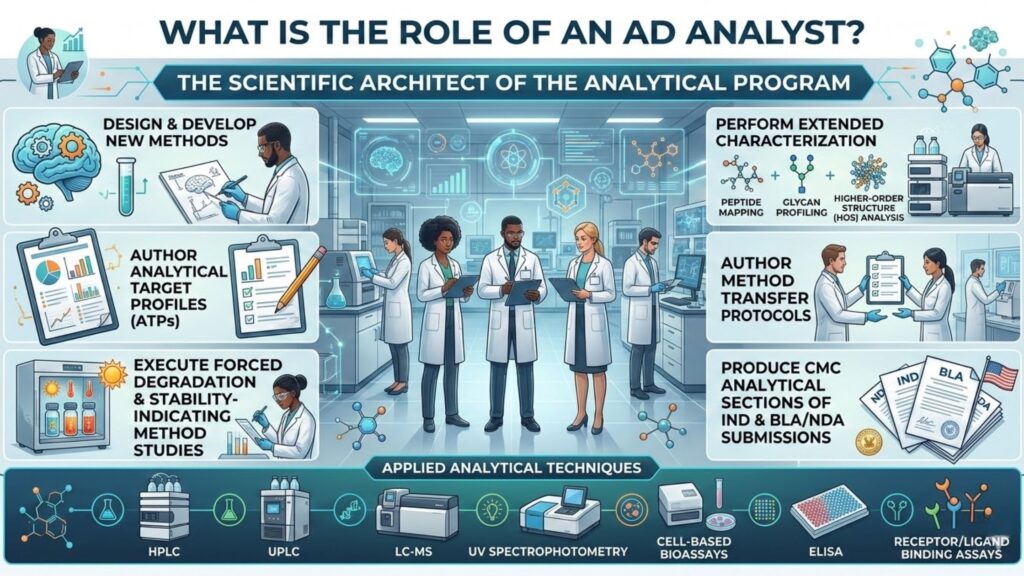
The role of an AD analyst is to serve as the scientific architect of the analytical program. AD analysts design and develop new methods, author Analytical Target Profiles (ATPs), execute forced degradation and stability-indicating method studies, perform extended characterization (peptide mapping, glycan profiling, higher-order structure analysis), author Method Transfer Protocols, and produce the CMC analytical sections of IND and BLA/NDA submissions. AD analysts apply techniques including HPLC, UPLC, LC-MS, UV spectrophotometry, cell-based bioassays, ELISA, and receptor/ligand binding assays
What Is Quality Control (QC) in Pharma?
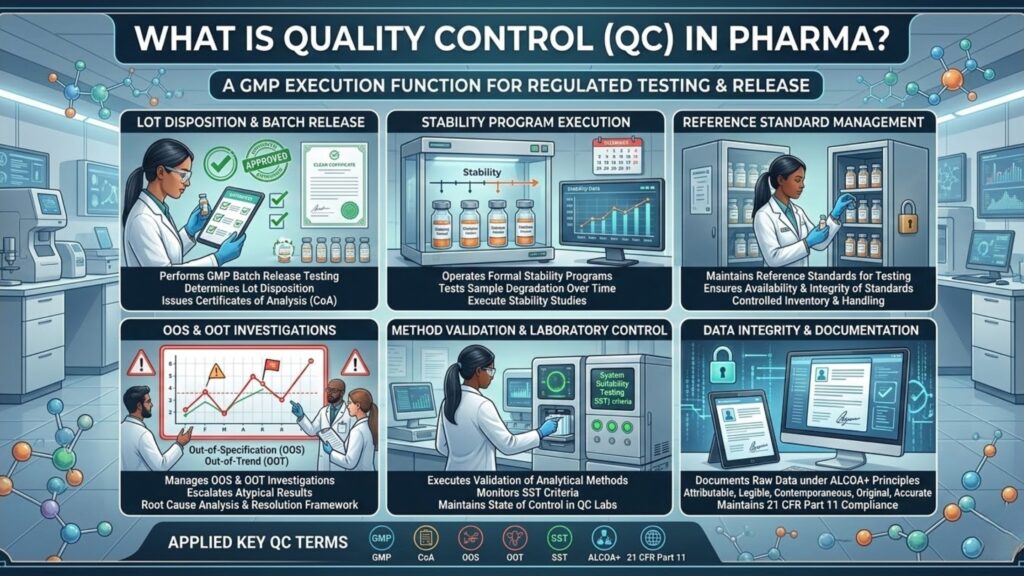
Quality Control (QC) in pharma is the GMP execution function responsible for regulated testing, lot disposition, batch release, stability program execution, reference standard management, and maintaining a state of control across all QC laboratory operations. QC performs GMP batch release testing, issues Certificates of Analysis (CoA), manages Out-of-Specification (OOS) and Out-of-Trend (OOT) investigations, operates the formal stability program, and maintains data integrity under 21 CFR Part 11. QC executes validation of analytical methods as defined, documents raw data under ALCOA+ principles, monitors system suitability testing (SST) criteria, and escalates atypical results through the formal OOS investigation framework.
QC functions are governed principally by 21 CFR Part 211, Subpart I (Laboratory Controls), 21 CFR 211.22 (Quality Control Unit responsibilities), ICH Q10 (Pharmaceutical Quality System), and applicable USP, Ph. Eur., and ICH standards.
What Is the Role of a QC Analyst?
The role of a QC analyst is to serve as the GMP custodian of analytical data integrity and batch disposition. QC analysts execute testing against transferred and validated methods, review raw data and batch records for conformance, manage OOS and OOT investigations, maintain instrument qualification and calibration records, support the formal stability program including pull scheduling and chain-of-custody, qualify and inventory reference standards, and author Method Transfer Reports following execution of AD-authored protocols. The QC analyst is the regulatory front line: every result they generate, every record they maintain, and every CoA they issue is a direct representation of the company’s GMP compliance posture.
AD vs. QC at a Glance: Phase-by-Phase Responsibility Framework
The table below summarizes the primary deliverables and decision rights of each function across three development phases of drug development.
| Stage | Analytical Development (AD) | Quality Control (QC) |
| Discovery to IND | Testing panel design; ATP development; CQA characterization; forced degradation (preliminary); Method Transfer Protocol; IND CMC sections (3.2.S / 3.2.P) | GMP lab SOPs; instrument qualification (USP <1058>); environmental monitoring; reference standard receipt; method transfer execution; Method Transfer Report; lot disposition authority (21 CFR 211.22) |
| Early Clinical Supply (Phase 1/2) | Forced degradation studies; orthogonal potency assay development; Analytical Control Strategy (ICH Q14); method qualification; comparability study design (ICH Q5E); critical reagent qualification; extended characterization | LIMS deployment (21 CFR Part 11); full GMP batch release; Phase 1/2 stability program; OOS/OOT investigations (21 CFR 211.192); method transfer report authorship; reference standard lifecycle management |
| Regulatory Filing & Commercial (Phase 3 / BLA / Post-Approval) | Full ICH Q2(R2) method validation; BLA/NDA Module 3.2.S & 3.2.P authorship; PPQ analytical protocol; Cpk/Ppk analysis; commercial specification finalization; PAI analytical readiness; post-approval change management (ICH Q12) | Commercial batch release; PPQ sample management; CPV/SPC monitoring for CQAs; commercial stability program; PAI laboratory walkthrough; market complaint testing; Field Alert Report triggering; Annual Product Review (APR) |
Discovery to IND: Establishing the Analytical Foundation
The pre-IND phase is where both AD and QC lay the groundwork for all future regulated operations. The scientific and infrastructural investments made at this stage directly determine the quality of the IND submission and the speed of Phase 1 clinical supply.
What AD Delivers in Discovery to IND
AD’s primary output in this stage is a fit-for-purpose analytical testing panel supporting IND enablement. This includes characterization of Critical Quality Attributes (CQAs): potency, purity, identity, and safety attributes specific to the molecule class. For biologics, this means host cell protein (HCP) assays, residual DNA, aggregation and fragment profiling, and charge heterogeneity analysis. AD develops the Analytical Target Profile (ATP) for each method, establishing the performance requirements (specificity, accuracy, precision, range) the method must meet to be fit for its intended purpose per ICH Q14.
AD establishes preliminary System Suitability Testing (SST) criteria and conducts initial stability-indicating method development through preliminary stress testing. Importantly, GLP-like analytical controls are phase-appropriate here. Full ICH Q2(R2) validation is not required for pre-IND work. AD also executes a critical comparability assessment between toxicology material and anticipated Phase 1 clinical batches, with a formal analytical risk assessment (FMEA) to identify and mitigate gaps.
Key AD service functions in this phase include:
- Testing panel development: minimum fit-for-purpose analytical package for IND support
- Modality-specific assay development: titer, potency, purity, identity, and safety attributes
- ATP development and documentation for all critical methods
- Analytical comparability assessment: tox material vs. Phase 1 clinical batch (FMEA)
- Container closure compatibility and extractables/leachables (E/L) risk assessment
- Reference material strategy: initial storage requirements and GMP qualification protocol design
- IND Module 3.2.S and 3.2.P analytical section authorship
- Method Transfer Protocol development for each method for GMP QC execution
What QC Builds in Discovery to IND
QC’s Phase 1 mandate is infrastructure: establishing GMP laboratory SOPs, instrument qualification, environmental monitoring (EM) programs, cleanroom controls, and a controlled document framework. QC establishes lot disposition authority and deploys reference material storage systems, and initiates the preliminary stability program. QC receives and verifies the Method Transfer Protocol from AD, executes qualification/verification activities, and authors Method Transfer Reports establishing the foundational handshake that governs the AD/QC relationship throughout the program.
Key QC service functions in this phase include:
- GMP laboratory SOP framework, logbooks, and controlled document system
- Instrument commissioning and qualification per USP <1058>
- Environmental monitoring (EM) program: settle plates, active air, particulate monitoring
- Lot disposition framework
- Reference standard receipt, primary qualification, labeling, and storage system
- Stability chamber qualification; preliminary stability program initiation
- QMS and deviation management system framework
- OOS/OOT/atypical result procedure development
- External CMO/CTO technical and quality agreement development
Early Clinical Supply: The Method Transfer Handshake and GMP Maturation
Early clinical supply represents the transition from GLP-like controls to full GMP analytical operations under 21 CFR Part 211. Both functions significantly expand their scope, and the quality of their collaboration at this stage has direct consequences for the End-of-Phase 2 (EOP2) meeting with FDA and the Phase 3 decision.
AD’s Expanding Role in Early Clinical Supply
In early clinical supply, AD executes comprehensive forced degradation studies (acid, base, oxidation, heat, photolysis) to establish mass balance, characterize degradation pathways, and confirm that all release and stability methods are genuinely stability-indicating. AD develops orthogonal potency assays — critical for biologics where a single mechanism-based assay alone may not sufficiently characterize potency. AD also builds the Analytical Control Strategy (ACS) per ICH Q14, formally documenting SST criteria, control charting thresholds, and performance monitoring requirements for each GMP method.
Comparability study design becomes an active AD responsibility whenever a GMP process change occurs (scale-up, formulation optimization, site transfer). AD designs the statistical comparability framework; QC governs GMP compliance of comparability batch execution.
Key AD service functions in this phase include:
- Forced degradation studies
- Analytical Control Strategy (ACS) development
- ATP maintenance and update based on Phase 1 manufacturing data
- Method Transfer Protocol development for all GMP-ready methods
- Extended characterization
- Critical reagent qualification and bridging studies for lot changes
- Comparability study design for all GMP process changes
- Specification refinement based on accumulated Phase 1/2 GMP batch data
QC’s GMP Buildout in Early Clinical Supply
QC deploys LIMS with line of sight on full 21 CFR Part 11 compliance, activating audit trails and electronic data capture for all GMP operations. QC executes full GMP batch release testing for Phase 1 and Phase 2 clinical material, issues CoAs, and manages the formal Phase 1/2 stability program, pull scheduling, chain-of-custody, and OOT investigations. When AD updates a Method Transfer Protocol for GMP-ready methods, QC executes the transfer experiments and authors the Method Transfer Report, retaining independent QC sign-off authority.
Key QC service functions in this phase include:
- LIMS deployment and audit trail activation
- Full GMP batch release testing for clinical material; CoA issuance
- Method transfer execution; OOS investigation SOP operationalization (Phase I and Phase II)
- Phase 1/2 stability program: long-term, accelerated, stressed studies
- Stability-indicating assay deployment and OOT trending across time points
- Reference standard lifecycle management: primary and working reference standard qualification execution
- Comparability study GMP governance: acceptance criteria verification, batch record sign-off
- External CMO/CTO oversight: qualification audits, method transfer at external sites, data integrity review
Regulatory Filing and Commercial: Full Validation and State of Control
The regulatory filing stage demands the highest analytical rigor. Both AD and QC must operate with commercial-level discipline from Phase 3 initiation, because PPQ batches, stability commitment batches, and filing data are all generated in this window.
AD’s Commercial and Filing Responsibilities
AD authors the analytical sections of module 3, including the Analytical Procedure Development Summary; ATP, development history, and analytical control strategy.
AD also leads the analytical component of PPQ support: developing the PPQ analytical protocol, providing real-time analytical troubleshooting during PPQ manufacturing, performing statistical analysis of PPQ data and authoring the analytical sections of the PPQ Report.
Key AD service functions in this phase include:
- BLA/NDA Module 3.2.S and 3.2.P analytical section authorship; ICH Q14 Analytical Procedure Development Summary
- PPQ analytical protocol development; real-time PPQ manufacturing support; Cpk/Ppk statistical analysis
- Commercial Analytical Control Strategy finalization; CPV framework design
- Multi-site reference standard qualification strategy; traceability chain documentation
- PAI analytical readiness: validation package completeness audit, raw data ALCOA+ review, mock PAI participation
- Post-approval analytical change management per ICH Q12: CBE-30, PAS, Annual Report classification
- E/L method development and validation for commercial container closure systems
QC’s Commercial Execution Responsibilities
QC completes full validation reports for every commercial release and stability-indicating method documenting accuracy, precision, specificity, linearity, range, LOD, LOQ, and robustness. QC executes commercial batch release testing, manages the PPQ sample testing program, operationalizes Continued Process Verification (CPV) with Statistical Process Control (SPC) charts for all CQAs, and manages the commercial stability program. QC leads the PAI laboratory walkthrough, audits OOS investigation files for regulatory defensibility, and manages multi-site reference standard qualification as commercial manufacturing scales.
Key QC service functions in this phase include:
- Method validation reports: accuracy, precision, specificity, linearity, range, LOD, LOQ, robustness
- Commercial GMP batch release testing; rapid release method support
- PPQ sample management: receipt, testing, chain-of-custody, batch record authorship
- CPV/SPC program: control charts for all CQAs, alert/action threshold monitoring
- Commercial stability program: commitment batches, OOT investigations, shelf-life extensions
- PAI laboratory walkthrough; OOS investigation file audit for regulatory defensibility
- Post-approval change management protocol (PACMP); Annual Product Review (APR)
- Market complaint sample testing; Field Alert Reporting (FAR) triggering (3-day clock); BPDR per 21 CFR 600.14 for biologics
- Multi-site CMO/CTO qualification and ongoing GMP audit program
Our Final Thoughts: The AD/QC Boundary Is a Competitive Advantage
Companies that maintain crisp capability boundaries between AD and QC execute cleaner method transfers, generate lower OOS rates, produce stronger BLA submissions, and pass Pre-Approval Inspections with greater confidence.
The cost of blurring the AD/QC boundary is not abstract. It manifests as repeated GMP runs due to poorly designed methods, OOS investigations that expose inadequate analytical development, and FDA questions on CMC submissions that require costly post-submission validation studies. Well-structured AD/QC frameworks built around the ATP, the Method Transfer Handshake, and phase-appropriate rigor is one of the highest-return investments a biotech company can make in its path to market authorization.
Dynamic Engineering Solutions provides integrated AD and QC pharma consulting across all phases of pharmaceutical and biologic development, from pre-IND analytical strategy through commercial lifecycle management. Our framework is built on the ICH regulatory architecture and operationalized for the realities of modern biotech development.

Isaac brings more than 25 years of experience in bio-pharmaceutical manufacturing and global supply chain leadership, specializing in CDMO selection, procurement, and network optimization.
Reach out to Isaac on LinkedIn.