

In the high-stakes ecosystem of the life sciences industry, ensuring product safety, efficacy, and consistency is far more than a corporate objective, it is a strict legal mandate. Whether a company is manufacturing lifesaving biopharmaceuticals, complex medical devices, novel cell and gene therapies, or over-the-counter medications, operations take place under a microscopic lens held by global regulatory authorities. At the heart of this operational matrix lies GxP, an umbrella term for “Good Practice” quality guidelines and regulations, with Good Manufacturing Practice (GMP) serving as its cornerstone for commercial production.
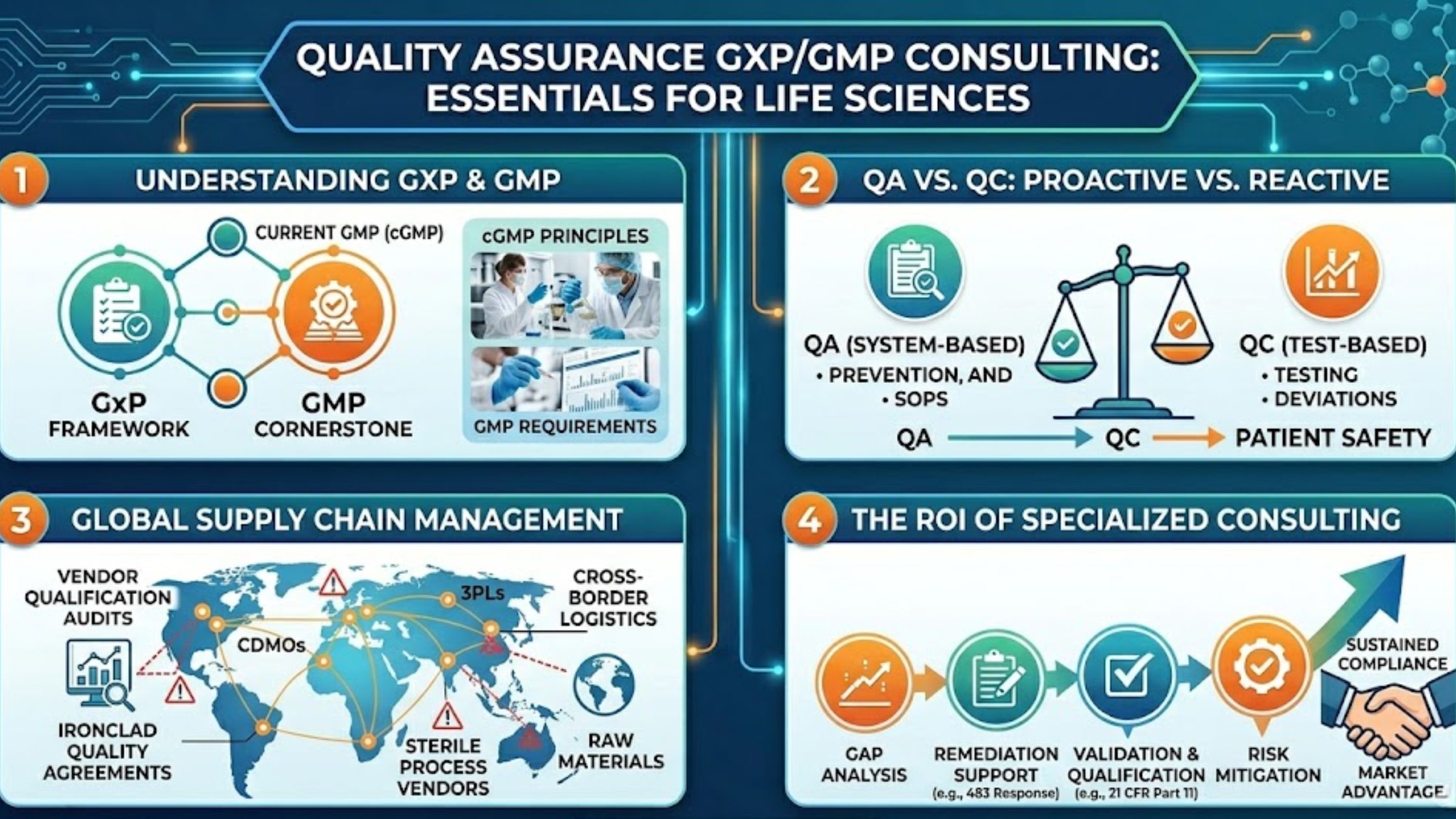
Achieving, maintaining, and defending compliance within this intricate ecosystem is an uphill battle. The regulatory landscape changes constantly, technologies evolve rapidly, and a single operational oversight can result in devastating product recalls, severe financial penalties, or compromised patient health. This is precisely where specialized Quality Assurance (QA) GXP/GMP consulting becomes indispensable. Partnering with external compliance experts allows life science organizations to navigate rigorous regulatory landscapes, optimize manufacturing workflows, and implement robust quality systems that pass inspections seamlessly.
Unpacking the GxP Spectrum and GMP Foundations
To fully appreciate the value of professional compliance services, it is critical to understand the breadth of the GxP framework. The lowercase “x” in GxP represents a variable that shifts depending on the specific lifecycle stage of a therapeutic product. For instance, Good Laboratory Practice (GLP) governs non-clinical laboratory safety and integrity studies, while Good Clinical Practice (GCP) protects patient rights, safety, and data integrity during human clinical trials.
However, when a drug or device transitions from development into commercial-scale manufacturing, GMP takes absolute precedence. In the United States, the Food and Drug Administration (FDA) enforces strict statutory rules known as Current Good Manufacturing Practices (cGMP). To ensure facilities maintain complete control over their operations, manufacturers must routinely cross-reference the official 21 CFR Part 211 standards, which detail the precise legal requirements governing finished pharmaceuticals, including personnel responsibilities, building design, and equipment sanitation.
The prefix “current” in cGMP underscores an ongoing challenge for life science firms: it requires companies to proactively employ up-to-date technologies and modern quality methodologies rather than relying on obsolete legacy systems. As emphasized in the FDA’s guidance on facts about current good manufacturing practices, flexibility is purposefully built into these regulations to allow companies to use innovative approaches for continual improvement. However, this flexibility demands a high degree of expert interpretation. Building an organizational framework that balances operational efficiency with uncompromising compliance requires a comprehensive grasp of quality assurance in the pharmaceutical industry, where preventive systems are woven into every single layer of the business.
Quality Assurance vs. Quality Control: A Strategic Distinction
A common pitfall in manufacturing operations is treating Quality Assurance (QA) and Quality Control (QC) as interchangeable concepts. In reality, they represent two distinct, yet highly complementary, pillars of a successful compliance strategy.
-
Quality Assurance (QA) is inherently proactive and process-oriented. It focuses on the overarching systemic architecture—such as standard operating procedures (SOPs), document control, staff training programs, facility environmental monitoring, and change management workflows—designed to prevent defects before they ever occur.
-
Quality Control (QC) is a reactive, product-oriented function. It relies on physical testing, laboratory assays, and raw material inspections to detect flaws in a batch before it leaves the facility.
GXP/GMP consultants assist organizations by seamlessly bridging the gap between QA design and QC execution. They ensure that all testing protocols are validated and that laboratory deviations are thoroughly investigated. Navigating these operational boundaries requires structured oversight, making it highly beneficial to review a deep dive into quality control in the pharmaceutical industry to understand how analytical testing verifies compliance at the micro-level.
Furthermore, consultants ensure that all documentation—the absolute bedrock of regulatory compliance—is thoroughly unassailable. In the eyes of an FDA or EMA auditor, “if it wasn’t documented, it never happened.” For this reason, consulting groups help implement strict data management guidelines based on harmonized GMP requirements published via PubMed Central, focusing heavily on data integrity principles like ALCOA+ (Attributable, Legible, Contemporaneous, Original, and Accurate) to prevent data falsification or accidental omissions.
Mitigating Vulnerabilities in the Pharmaceutical Supply Chain in 2026
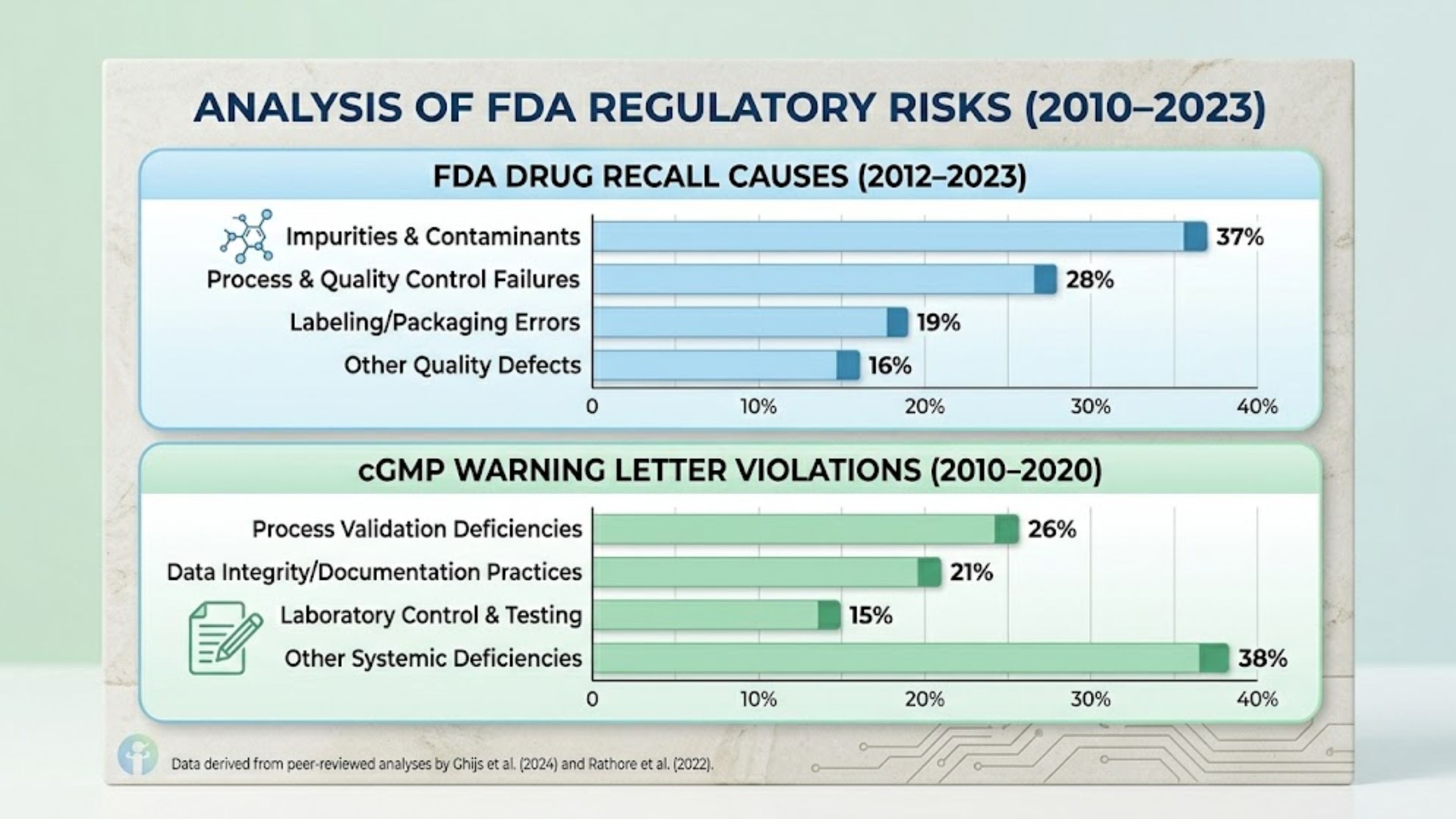
Modern drug manufacturing is rarely confined to a single location. Instead, it relies on an intricate, global web of raw material suppliers, contract development and manufacturing organizations (CDMOs), third-party logistics providers (3PLs), and specialized packaging vendors. This decentralized approach introduces massive compliance vulnerabilities. If an active pharmaceutical ingredient (API) is exposed to temperature deviations during international transit, or if a supplier fails to validate their cleaning processes, the entire final product batch can be compromised.
Managing these complex vulnerabilities requires comprehensive visibility across all distribution channels. Proactive organizations must study pharma supply chain fundamentals and challenges to design risk-mitigation protocols that withstand cross-border logistics issues, raw material shortages, and regulatory shifts.
GXP/GMP consultants provide immense value here by executing rigorous vendor qualification audits, establishing ironclad Quality Agreements, and verifying that the entire distribution network remains fully aligned with current regulatory expectations. Furthermore, consultants track comprehensive updates found within the centralized FDA CMC and GMP guidances list to safeguard Chemistry, Manufacturing, and Controls (CMC) metrics across international distribution channels.
The Tangible ROI of GXP/GMP Consulting Partnerships
Investing in a specialized consultancy is not merely a cost of doing business; it is a high-value strategy that protects a company’s market share, brand reputation, and capital. When companies engage with experienced advisors, they gain access to specialized knowledge that is rarely available entirely in-house.
A professional compliance consulting group assists life science companies through several critical lifecycle phases:
-
Gap Analysis and Auditing: Evaluating current facilities, computerized systems, and procedures against international expectations to pinpoint compliance vulnerabilities before official regulatory inspectors find them.
-
Regulatory Inspection Readiness: Conducting mock audits, training subject matter experts (SMEs) on how to interface with investigators, and establishing rapid-response “war rooms” for active inspections.
-
Remediation Support: If an organization receives an adverse finding, such as an FDA Form 483 or a Warning Letter, consultants craft meticulous Corrective and Preventive Action (CAPA) plans to swiftly resolve the issues and restore regulatory standing.
-
Validation and Qualification: Authoring and executing robust protocols for equipment qualification (IQ/OQ/PQ), software validation (including 21 CFR Part 11 compliance), and complex sterile process validations.
For a strategic roadmap on selecting the right partner to design these custom compliance programs, organizations can reach out to pharmaceutical consultants such as DES Pharma. By relying on seasoned industry veterans, life sciences firms significantly accelerate their timeline to market while avoiding costly operational re-work. Staying ahead of these standards requires utilizing tools like the FDA guidance document search portal, ensuring that every standard operating procedure matches the latest expectations from regulatory officials.
Our TLDR: Cultivating a True Culture of Quality in 2026
Ultimately, passing a regulatory audit is not a one-time event, it is the natural byproduct of a deeply ingrained corporate culture of quality. Quality assurance GXP/GMP consulting equips life sciences organizations with the technical systems, employee training, and strategic clarity required to transform compliance from a burdensome checklist into a competitive market advantage.
By proactively integrating robust quality assurance frameworks, securing supply chains, validating methodologies, and maintaining data integrity, companies can confidently deliver safe, effective, and reliable therapies to the patients who need them most.

Alex has 20+ years of experience in the CMC space, specializing in CDMO/CRO management, analytical development, technology transfer, quality and regulatory compliance for various drug modalities across multiple product stages.
Reach out to Alex on LinkedIn.