


What Is the Difference Between ICH Q2 and Q14?
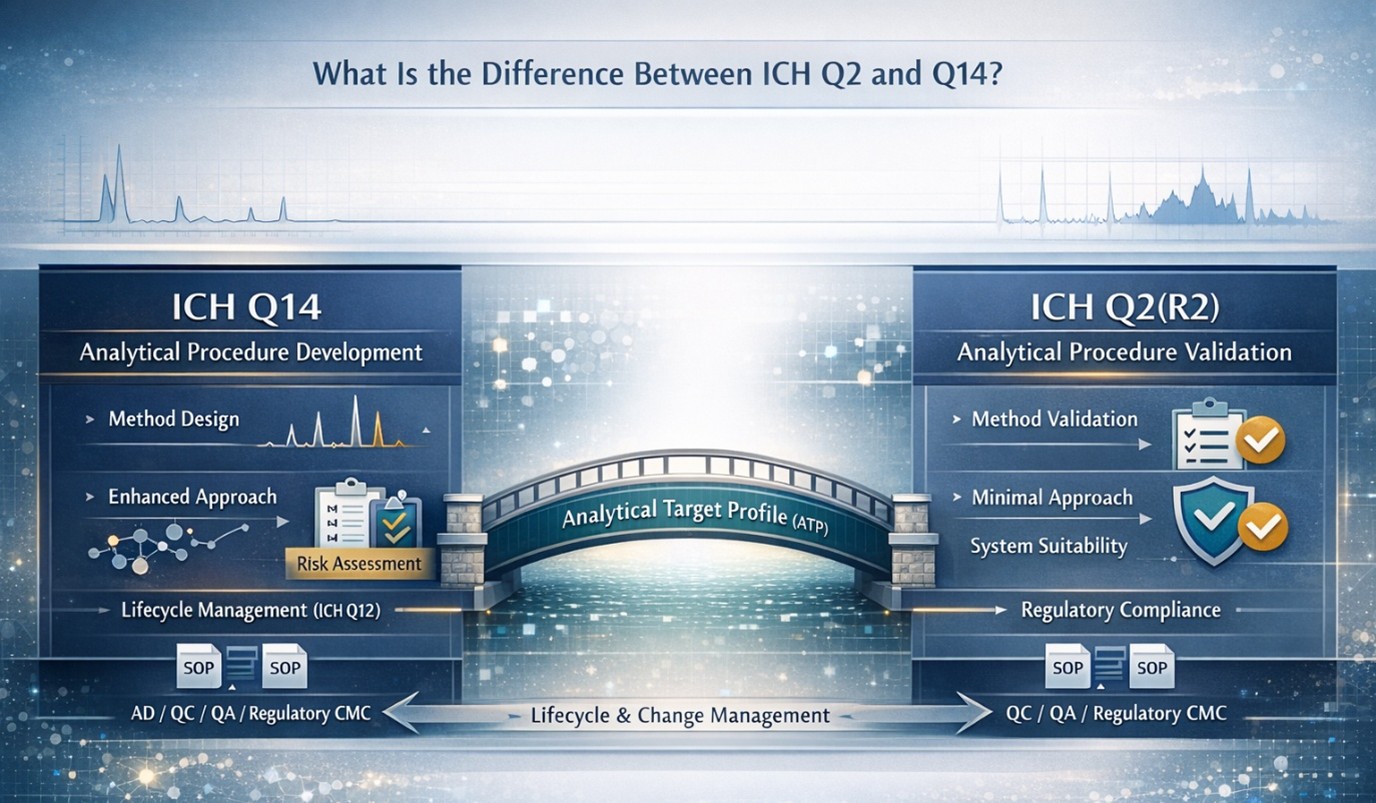
If your team is asking whether ICH Q2(R2) and ICH Q14 say the same thing, the answer is no. They were designed to work together, but do different jobs. ICH Q14 explains how an analytical procedure should be developed. ICH Q2(R2) explains how that procedure should be validated. One is about building the method with a clear scientific rationale. The other is about demonstrating, with documented evidence, that the method performs as intended.
That distinction matters more now than it did under the older Q2(R1). For many years, companies treated method development and method validation as loosely connected activities. A procedure might be developed in one group, transferred with limited explanation, and then validated as a separate exercise. ICH finalized ICH Q14 and ICH Q2(R2) together in late 2023, and FDA announced the final guidances in March 2024. They make the relationship much more explicit: development is expected to be structured, science-based, and tied to intended performance, while validation is expected to confirm that the resulting procedure is fit for purpose.
For Analytical Development, this is not a semantic distinction. It changes how procedures are planned, what data are worth generating during development, how the Analytical Target Profile (ATP) is defined, how robustness and system suitability are justified, and how later changes can be supported through the analytical procedure lifecycle. For Quality Control, Quality Assurance, and Regulatory CMC, it changes how the method story should be reviewed, documented, defended, and maintained.
Why This Question Matters
This question matters because regulators now expect development and validation to be read as one connected story rather than two separate documents. A method that was never designed around a defined performance target is difficult to validate well. A method that is validated without enough development understanding is difficult to transfer, maintain, and change later. In practice, the difference between ICH Q14 and ICH Q2(R2) affects development depth, robustness strategy, validation design, post-approval change planning, and the way different functions share ownership of the method.
What Exactly is ICH Q14?
ICH Q14 is the guideline for analytical procedure development. Its purpose is to describe science-based and risk-based approaches for building analytical procedures that are suitable for evaluating the quality of drug substances and drug products. It also links development knowledge to lifecycle management and change control.
The key idea in ICH Q14 is that method development should start with the method’s intended purpose and required performance, not with an instrument setting copied from a legacy procedure. ICH Q14 introduces the Analytical Target Profile (ATP), as the development pillar. The ATP states what the analytical procedure must measure, in what material, for what use, and with what expected level of performance. That means the method is designed backward from the decision it needs to support.
ICH Q14 also distinguishes between a minimal approach and an enhanced approach. The minimal approach is acceptable and aligns with more traditional development practice. The enhanced approach uses deeper procedure understanding, planned experimentation, risk assessment, and justified parameter ranges to build a more durable method package. That deeper understanding can support a stronger control strategy and, in the right filing context, more efficient management of post-approval changes.
Notably, ICH Q14 does not replace validation. It sets up validation. It explains how development activities, development knowledge, risk assessment, and parameter studies create the foundation that ICH Q2(R2) later tests in a formal validation package.
And What is ICH Q2(R2)?
ICH Q2(R2) is the guideline for analytical procedure validation. Its purpose is to present the elements that should be considered when validating analytical procedures included in registration applications. In plain language, it asks one central question: does this analytical procedure reliably do what the sponsor says it needs to do?
ICH Q2(R2) covers the performance characteristics and validation studies used to answer that question. Depending on the analytical use, that can include selectivity or specificity, reportable range, response, lower range limits where relevant, accuracy, precision, and validation of stability-indicating properties. It also reflects newer expectations for a broader set of analytical technologies, including multivariate and spectroscopic approaches, rather than focusing only on classic single-analyte testing. The document also makes the lifecycle connection explicit. Validation is described as part of the analytical procedure lifecycle, not as a detached final event. ICH Q2(R2) recognizes that suitable data collected during development studies under Q14 can contribute to validation when scientifically justified.
The ATP is the Crucial Bridge Between Q14 and Q2(R2)
The most important concept linking the two guidelines is the ATP. Under ICH Q14, the ATP defines the intended purpose of the analytical procedure and the performance criteria it needs to meet. It plays a role like the Quality Target Product Profile (QTPP) in ICH Q8(R2), but for the method rather than the product.
That means the ATP is not a decorative document. It is the bridge between development and validation. The method is developed under ICH Q14 to meet the ATP. The method is then validated under ICH Q2(R2) to demonstrate that it does in fact meet that ATP. Once you see that relationship, the difference between the two guidelines becomes much easier to manage.
In real-world, a strong ATP usually answers questions such as:
- What attribute is being measured
- Which sample or matrix the procedure applies to
- Which decision the result will support, such as release, stability, potency, impurity control, or characterization
- What level of specificity, accuracy, precision, and range is needed
- Which limits or reporting thresholds matter for the product and stage of development
A weak ATP usually leads to a weak validation strategy, because the team is trying to prove suitability without first defining suitability clearly.
So What Exactly Changed in ICH Q2(R2) Compared with the Older Way of Thinking?
ICH Q2(R2) is not just the older validation guideline with minor edits. It places validation more clearly within the analytical procedure lifecycle and ties validation more directly to intended use and procedure knowledge. It also updates the framework around reportable range, response, and lower range limits, and it allows development data to support validation where that use is scientifically justified. For companies still relying on older ICH Q2(R1)-style templates, that is an important shift.
For sponsors, the takeaway is simple. If your validation template still reads like a standalone checklist that ignores how the method was developed, it may not reflect the current regulatory mindset.
Minimal Versus Enhanced Approach Under ICH Q14
ICH Q14 does not require every analytical procedure to be developed through a fully enhanced package. The guideline clearly allows a minimal, or traditional, approach, as well as elements of an enhanced approach where appropriate. The enhanced approach uses deeper method understanding, planned experimentation, and risk assessment to understand which parameters affect performance and how. That added understanding can improve robustness and transfer readiness, and it can also support a more structured postapproval change strategy when paired appropriately with ICH Q12 tools.
How ICH Q12 fits into the picture
ICH Q12 is not the main comparison in this article, but it is part of the practical picture. ICH Q14 generates development knowledge. ICH Q2(R2) provides the validation framework. ICH Q12 provides lifecycle tools that can make postapproval analytical changes more predictable when the underlying method understanding is strong enough to support them. In that sense, ICH Q12 is not a substitute for ICH Q14 or ICH Q2(R2); it is the lifecycle framework that helps turn method understanding into a more manageable regulatory change strategy.
Who owns the ICH Q14 story and the ICH Q2(R2) validation package?
Ownership is one of the places teams often get confused. Analytical Development typically leads the ICH Q14 story by defining the ATP, selecting the technology, building procedure understanding, and shaping the validation strategy. ICH Q2(R2) validation then becomes a cross-functional package: Quality Control contributes execution readiness and late-stage performance data, Quality Assurance oversees compliance and governance, and Regulatory CMC integrates the development and validation narrative into the dossier. When those functions are not aligned, the submission package usually shows it.
A Practical Example
Consider a stability-indicating impurity method for a biologic product. Under ICH Q14, the team starts by defining the ATP. The intended use may be release and stability trending of known and unknown degradants at defined reporting thresholds. Development then explores separation conditions, sample preparation, expected degradation pathways, matrix effects, parameter sensitivity, and system suitability logic. If the team follows an enhanced approach, it may also run formal range studies and multivariable experiments to understand how pH, gradient timing, column temperature, and buffer composition affect resolution and quantitative reliability.
Only after that development package is mature does ICH Q2(R2) take over as the validation framework. The company then validates selectivity, accuracy, precision, reportable range, and stability indicating properties using the finished procedure. The validation package is not built in isolation. It is built on the knowledge generated under ICH Q14.
That is the real difference. ICH Q14 tells you how to develop the procedure intelligently. ICH Q2(R2) tells you how to confirm, with formal evidence, that the procedure is fit for purpose.
5 Common mistakes when teams compare ICH Q2 and ICH Q14
- Thinking ICH Q14 is optional theory while ICH Q2(R2) is the only document that matters.
- Treating ATP language as a formality instead of the anchor for development and validation.
- Pushing robustness work into late validation rather than building it during development.
- Assuming every method needs a fully enhanced development package even when risk and complexity do not justify it.
- Assuming validation alone can rescue a poorly understood method.
Most remediation work in this area comes from one root cause: the company tries to prove more than it took time to understand.
So, What is the Real Difference Between ICH Q2 and ICH Q14?
ICH Q14 governs analytical procedure development, while ICH Q2(R2) governs analytical procedure validation. ICH Q14 begins with intended purpose, the ATP, and procedure understanding. ICH Q2(R2) uses that foundation to define and execute the validation studies needed to show that the procedure is fit for purpose. Read together, the two guidelines move the industry away from a checklist view of methods and toward a lifecycle view in which procedures are expected to be understandable, transferable, and maintainable over time.
For companies building or revising analytical strategies, the most valuable question is no longer, “Which document matters more?” The better question is, “Have we developed the method under ICH Q14 in a way that makes ICH Q2(R2) validation clear, efficient, and defensible?”
Partner with DES Pharma Consulting
DES Pharma Consulting supports sponsors with analytical development strategy, phase-appropriate method packages, validation planning, transfer readiness, and Regulatory CMC positioning across the product lifecycle. If your team is aligning legacy methods or new procedures to ICH Q14 and ICH Q2(R2), DES is your ideal pharma consultanting to help structure the method story so it is technically sound, inspection-ready, and submission-ready.

Alex has 20+ years of experience in the CMC space, specializing in CDMO/CRO management, analytical development, technology transfer, quality and regulatory compliance for various drug modalities across multiple product stages.
Reach out to Alex on LinkedIn.