
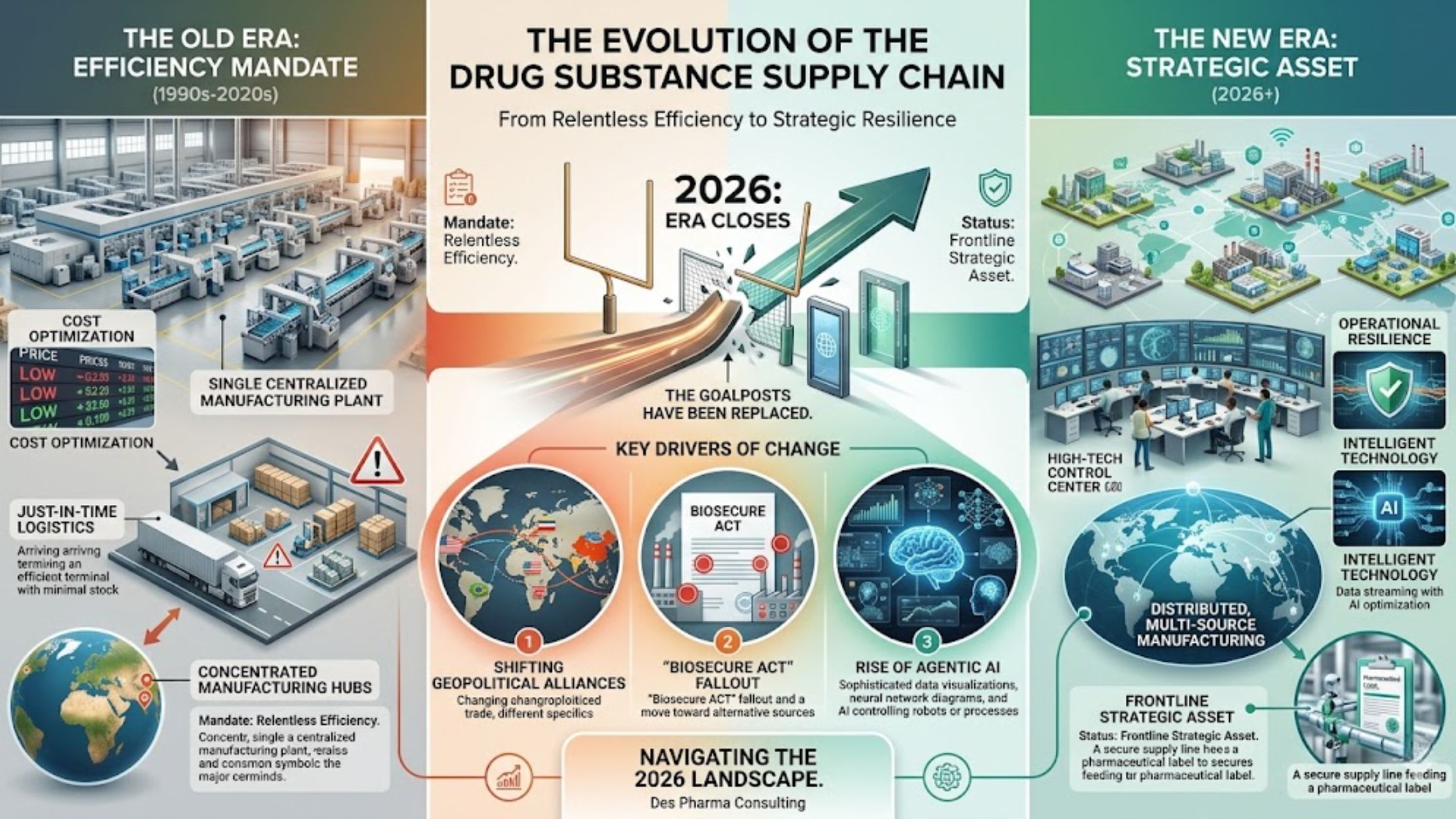
For decades, the pharmaceutical industry operated under a singular, relentless mandate: efficiency. Pharmaceutical consultants have traditionally optimized for cost, leaned into “just-in-time” logistics, and concentrated our manufacturing in a handful of high-volume hubs. But as we navigate the landscape of 2026, that era has officially drawn to a close.
In the current climate, the Drug Substance (DS) supply chain is no longer just a backend operational concern, it is a frontline strategic asset. Between shifting geopolitical alliances, the “BIOSECURE Act” fallout, and the rise of agentic AI, the goalposts haven’t just moved; they’ve been replaced.
We’ve seen how the complexity of sourcing Active Pharmaceutical Ingredients (APIs) and their intermediates has evolved. As drug development consultants we have expertise to offer our deep dive into the trends, challenges, and strategies defining the drug substance supply chain today.
1. The Geopolitical Chessboard: Beyond Globalization
The “global village” of pharmaceutical manufacturing is currently undergoing a period of intense fragmentation. In 2026, the primary driver for supply chain decisions isn’t speed or even unit cost, it’s sovereignty.
The “China+1” Strategy and Onshoring
With the full implementation of the BIOSECURE Act and escalating tariffs (reaching upwards of 25% on certain APIs sourced from specific regions), the “China+1” strategy has shifted from a boardroom suggestion to a survival requirement.
-
Onshoring and Nearshoring: We are seeing a massive pivot toward domestic manufacturing and regional hubs in the US, EU, and India.
-
The Cost of Security: Resilience comes with a price. Companies are now qualifying secondary sources even when they cost 15–20% more. This “Resilience Premium” is being absorbed as an insurance policy against the catastrophic cost of a drug shortage.
Tariffs and the Margin Squeeze
The Inflation Reduction Act (IRA) and its Medicare Drug Price Negotiation Program have put immense pressure on margins. When you combine reduced list prices with a 15% tariff on sterile packaging or glass vials from Asia, the math for small-molecule drugs becomes incredibly tight.
2. The Digital Nervous System: AI and Blockchain
If 2024 was the year of “AI hype,” 2026 is the year of AI integration. We have moved past simple automation into a “connected ecosystem” where data flows seamlessly between suppliers, CDMOs, and regulators.
Predictive vs. Reactive Analytics
Traditional supply chains were reactive – you found out about a bottleneck when the ship didn’t arrive. Today, predictive models flag potential shortages 6–12 months in advance. These systems analyze everything from a supplier’s financial health to local weather patterns and regulatory inspection outcomes.
Immutable Transparency
Blockchain has matured from a buzzword into the backbone of track-and-trace. With the November 2026 deadlines for final dispenser implementation of serialization laws, an immutable record of every transaction—from the raw chemical precursor to the final patient—is now a standard expectation.
| Feature | Traditional Supply Chain (Pre-2020) | Modern Supply Chain (2026) |
| Primary Goal | Cost Minimization | Operational Resilience |
| Inventory | Just-in-Time (Lean) | Strategic Safety Stocks |
| Sourcing | Single-Source (Cost-Optimized) | Multi-Source (Geographically Diverse) |
| Data Flow | Siloed / Manual | Connected / AI-Driven |
| Sustainability | “Nice to Have” | Regulatory Requirement (ESG) |
3. Sustainability: Green Chemistry as the “Entry Ticket”
In 2026, environmental sustainability is no longer a PR exercise; it is an audit requirement. Green chemistry is now the “entry ticket” for any supplier looking to join a mainstream pharmaceutical supply chain.
-
Low-Carbon Processes: Large pharma companies are now demanding “deliverable + auditable” carbon data. If your API synthesis involves high-VOC solvents or energy-intensive steps without a mitigation plan, you are a liability.
-
Biocatalysis: We are seeing a surge in enzymatic processes that replace traditional transition metal catalysts. Biocatalysis is not only “greener” but often yields higher purity profiles, reducing the downstream purification burden.
-
PMI Tools: The use of Process Mass Intensity (PMI) tools is now standard in CMC (Chemistry, Manufacturing, and Controls) development to measure the total amount of material used per kilogram of drug substance.
4. Technical Innovation: Continuous Manufacturing and mRNA
The “batch” mindset is slowly being replaced by flow chemistry and continuous manufacturing (CM).
The Rise of Continuous Manufacturing
CM allows for a smaller physical footprint and real-time quality monitoring. For drug substances that are highly potent or unstable, CM provides a level of control that traditional batch manufacturing simply cannot match. This technology is a cornerstone for companies looking to “onshore” production, as the highly automated nature of CM helps offset higher labor costs in Western markets.
The mRNA Revolution
The infrastructure built during the pandemic has evolved. We now have specialized supply chains for lipid nanoparticles (LNPs) and raw materials for RNA synthesis that are more robust and standardized than ever before. This has paved the way for a new generation of “plug-and-play” drug substance platforms.
5. Regulatory Compliance and Quality by Design (QbD)
The regulatory landscape in 2026 is more harmonized yet more demanding. ICH Q12 (Technical and Regulatory Considerations for Pharmaceutical Product Lifecycle Management) is fully operational, allowing companies to manage post-approval changes more efficiently—if they have a robust understanding of their process.
At Des Pharma Consulting, we emphasize that Quality by Design (QbD) is the only way to navigate these complexities. By defining the “design space” of a drug substance early, manufacturers can swap suppliers or tweak processes without the need for exhaustive, multi-year regulatory filings.
6. How to Understand the Chaos
The drug substance supply chain is no longer a linear path; it’s a multidimensional web of risk and opportunity. Moving through this requires more than just a spreadsheet; it requires deep technical expertise and a proactive regulatory strategy:
-
Risk Mitigation: We conduct deep-dive audits of your supplier network, identifying “single-point-of-failure” risks before they manifest as shortages.
-
Tech Transfer Excellence: Moving a drug substance process from a Chinese CDMO to a domestic site is fraught with technical “gotchas.” We manage the transfer to ensure batch-to-batch consistency.
-
Digital Readiness: One must integrate the AI tools and serialization protocols necessary to meet the 2026 transparency mandates.
Moving Forward with Drug Substance Supply Chain: The Future is Resilient
The challenges of 2026: geopolitical friction, margin compression, and rigorous ESG standards are formidable. However, they also present an opportunity to build a supply chain that is smarter, greener, and more reliable than the one we left behind.
In the world of drug substance, certainty is the new currency. Whether you are a small biotech looking to secure your first clinical supply or a large-cap firm recalibrating your global footprint, the time to build for resilience is now. Get in touch with DES Pharma today for a free consultation.

Isaac brings more than 25 years of experience in bio-pharmaceutical manufacturing and global supply chain leadership, specializing in CDMO selection, procurement, and network optimization.
Reach out to Isaac on LinkedIn.