

Good Manufacturing Practice (GMP) is the lifeblood of the pharmaceutical industry. It is the minimum standard that a medicines manufacturer must meet in their production processes. But because the regulatory landscape, governed by bodies like the FDA, EMA, and MHRA—is continuously shifting, pharmaceutical companies frequently rely on pharma consultants including external GMP consultants to bridge knowledge gaps, maintain compliance, and avoid catastrophic operational halts.
Here is a comprehensive look at the realities, functions, and value of GMP consulting in the pharmaceutical sector.
What Does a GMP Pharma Consultant Actually Do?
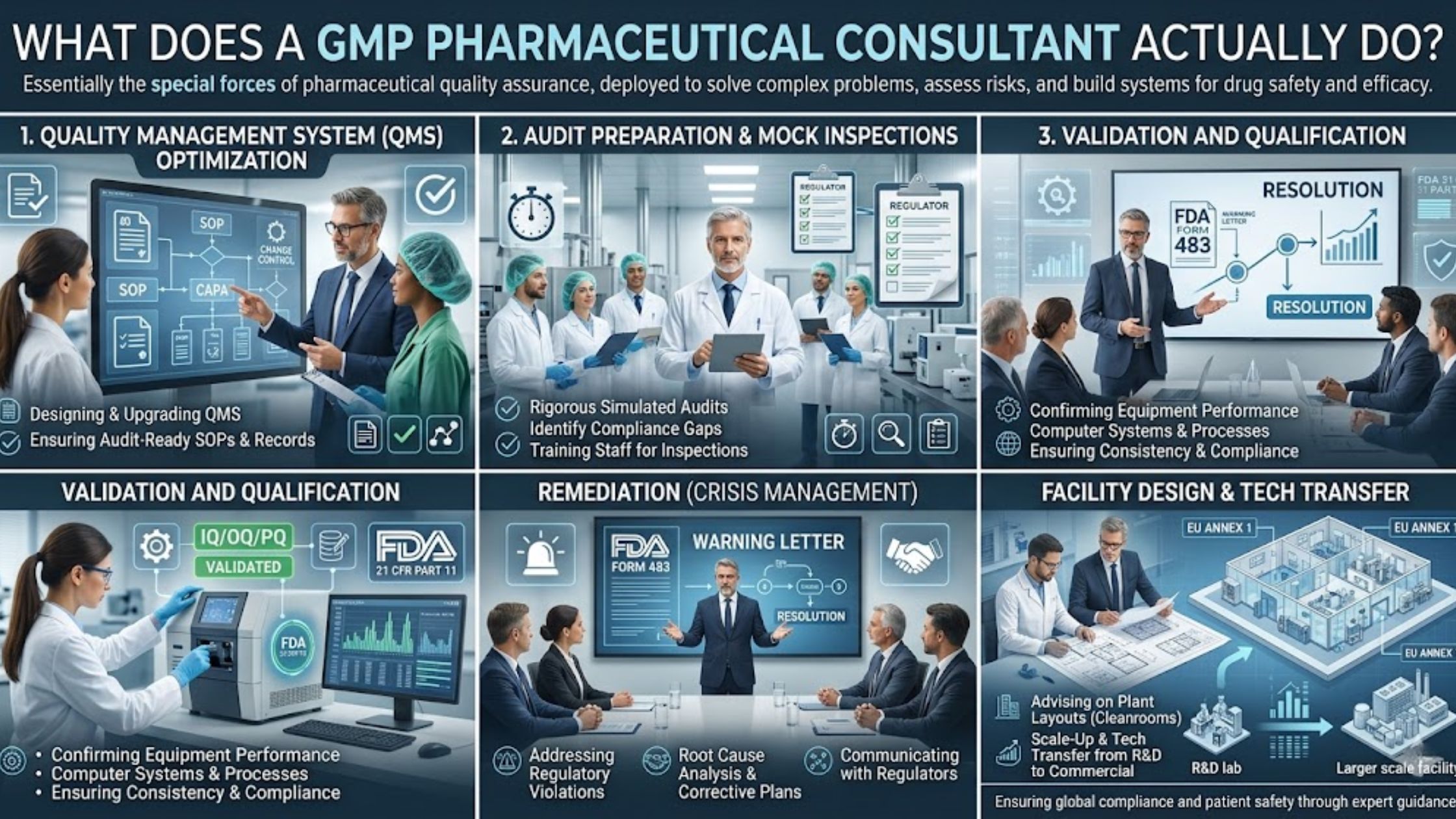
GMP consultants are essentially the special forces of pharmaceutical quality assurance. They are deployed to solve complex problems, assess risks, and build systems that ensure drug safety and efficacy. Their core responsibilities typically fall into these distinct categories:
-
Quality Management System (QMS) Optimization: Designing, implementing, or upgrading a facility’s QMS to ensure all standard operating procedures (SOPs), CAPAs (Corrective and Preventive Actions), and change controls are audit-ready.
-
Audit Preparation and Mock Inspections: Conducting rigorous, simulated audits to identify compliance gaps before official regulatory bodies step foot in the facility.
-
Validation and Qualification: Ensuring that equipment (IQ/OQ/PQ), processes, and computer systems (like those governed by FDA 21 CFR Part 11) consistently do what they are supposed to do.
-
Remediation (Crisis Management): Stepping in after a company has received an FDA Form 483 (notice of inspectional observations) or a Warning Letter to fix the root causes of the violations and communicate the corrective plan to regulators.
-
Facility Design and Tech Transfer: Advising on the layout of new manufacturing plants (especially cleanrooms and sterile environments per EU Annex 1) and ensuring the seamless transfer of manufacturing processes from R&D to commercial scale.
When Do Pharma Companies Need GMP Consultants?
Companies don’t just hire GMP consultants or drug development consultants because they have surplus budget; they hire them at critical inflection points.
| Strategic Inflection Point | Why a Consultant is Brought In |
| Scaling from Clinical to Commercial | Startups and biotechs often lack the rigid infrastructure required to mass-produce drugs safely. Consultants build the commercial-grade QMS from scratch. |
| Post-Inspection Remediation | When a company fails an audit, internal teams are often too close to the problem (or lack the specific expertise) to fix it. Consultants provide objective, rapid triage. |
| Entering New Global Markets | A facility compliant with US FDA standards may not immediately pass a European Medicines Agency (EMA) audit. Consultants translate regional regulatory nuances. |
| Implementing New Technology | Moving from batch manufacturing to continuous manufacturing, or implementing AI-driven quality controls, requires specialized validation expertise that most in-house QA teams lack. |
The Unbiased Reality: 3 Pros and 3 Cons
Like any external service, relying on GMP consultants comes with distinct advantages and inherent risks. A balanced view is critical for any pharma executive making hiring decisions.
The Pros:
-
Complete Objectivity: An external consultant has no internal political ties. They will point out a flawed process bluntly, which is exactly what you need before an FDA investigator does the same.
-
Hyper-Specialized Expertise: If you need to validate a highly specific lyophilizer (freeze-dryer) or a complex LIMS (Laboratory Information Management System), it is faster to hire an expert for three months than to train an internal employee.
-
Speed and Agility: Consultants are accustomed to parachuting into high-stress environments and immediately executing gap analyses and remediation plans.
The Cons:
-
High Cost: Top-tier GMP consultants are expensive, often billing hundreds of dollars per hour. Prolonged engagements can drain budgets.
-
Knowledge Drain: If a company heavily relies on a consultant to build a system but fails to train their internal staff to maintain it, the compliance knowledge walks out the door when the consultant’s contract ends.
-
Cultural Resistance: Internal QA/QC teams sometimes view consultants as threats or critics, leading to friction that can slow down project implementation.
3 Trends Shaping the Future of GMP Consulting
The landscape of GMP consulting is evolving rapidly to keep pace with scientific and technological advancements.
-
Data Integrity: With the rise of automated manufacturing, regulators are hyper-focused on data integrity (ALCOA+ principles). Consultants are increasingly hired purely to audit software systems to ensure data cannot be manipulated.
-
Advanced Therapy Medicinal Products (ATMPs): Cell and gene therapies have incredibly complex, patient-specific supply chains. Consultants with expertise in the unique GMP requirements for ATMPs are currently in massive demand.
-
Sustainability and Green Chemistry: As ESG (Environmental, Social, and Governance) mandates grow, consultants are beginning to advise on how to implement greener manufacturing processes without altering the validated state of the drug.
Whether a company is a nimble biotech startup or an established global manufacturer, GMP consultants act as the crucial safety net between the science of drug development and the strict reality of global compliance. Get in touch with DES Pharma to better understand your GMP consulting needs.

Matt specializes in Process Development (PD) and Chemistry, Manufacturing, and Controls (CMC) strategy, helping life sciences companies navigate early-stage development, lab innovation, and technical regulatory hurdles.
Reach out to Matt on LinkedIn.