


Analytical method development is one of the areas in pharmaceutical development where a program either gains control or begins to accumulate avoidable risk. A method may appear acceptable during early work, then fail when the sample matrix changes, the product ages, a second analyst runs it, or the procedure comes under regulatory review. In practice, the difference between a robust method and a fragile one is rarely the instrument alone. It is the quality of the development strategy behind it.
That is why analytical method development and validation should not be treated as separate, sequential tasks. They are parts of a single analytical method lifecycle. Development defines what the method must measure, how it will do so, and should perform reliably. Validation then demonstrates, with documented evidence, that the procedure is fit for its intended use. When development is poorly framed, validation becomes difficult to justify. When development is deliberate, validation is more efficient, more meaningful, and easier to defend.
The current regulatory baseline reflects that lifecycle view. International Council for Harmonisation (ICH) Q14 describes science- and risk-based analytical method development, while ICH Q2(R2) provides the framework for validation of analytical methods as part of the analytical method lifecycle. For bioanalytical methods, ICH M10 remains the key reference for bioanalytical method validation and study sample analysis. The United States Food and Drug Administration (FDA) guidance on Analytical Procedures and Methods Validation for Drugs and Biologics also remains an important practical submission reference. Together, these documents align analytical method development, analytical validation, and lifecycle control much more closely than older “develop first, validate later” models.
In practical terms, analytical method development sits at the center of Analytical Development (AD), Quality Control (QC), Chemistry, Manufacturing, and Controls (CMC), and regulatory planning. Early choices around sample preparation, selectivity, degradation coverage, robustness, system suitability, transfer strategy, and validation scope often resurface later as out-of-specification (OOS) results, transfer failures, weak comparability/characterization packages, or preventable filing questions. That is exactly why strong pharmaceutical analytical development is not just a laboratory activity. It is a program risk-control activity.
What Strong Analytical Method Development Should Deliver
At its core, analytical method development is the disciplined process of building a procedure that can answer the right quality question for the sample, across a pre-defined range, with a high level of confidence. It is not a generic instrument setup exercise, and it is not simply a pre-validation formality.
Before selecting a column, tuning a source, or setting a gradient, the team should be able to state one of the 7 following:
- What attribute is being measured
- Which sample type and matrix are involved
- The expected concentration range
- What decision the result will support
- The required sensitivity, precision, and selectivity
- The stage of development in which the method will be used
- Is the appropriate mechanism of action addressed (for potency only)
That intended use drives everything that follows. A release assay, a stability-indicating impurity method, a characterization procedure, and a bioanalytical method are not developed or justified in the same way. If the intended use remains vague, the method may still generate data, but it will not generate dependable regulatory evidence.
The Regulatory Baseline for Method Development and Validation
For teams looking for the current regulatory baseline for analytical method development and analytical method validation, the answer starts with International Council for Harmonisation (ICH) Q14 and ICH Q2(R2). Q14 describes how analytical procedures should be developed using science- and risk-based principles, including use of the Analytical Target Profile (ATP), knowledge management, development rationale, and lifecycle thinking. Q2(R2) explains how validation characteristics should be selected and evaluated based on intended use and how validation should be understood as part of the broader analytical method lifecycle rather than as a stand-alone exercise. FDA’s guidance on Analytical Procedures and Methods Validation for Drugs and Biologics remains highly relevant because it continues to reflect what sponsors are expected to submit in drug and biologic applications, including the distinction between validation of non-compendial methods and verification of compendial procedures.
For bioanalytical procedures, ICH M10 adds the operational detail many teams need for liquid chromatography-mass spectrometry (LC-MS) and liquid chromatography-tandem mass spectrometry (LC-MS/MS) assays, including expectations around matrix effects, carryover, stability in matrix and processed samples, partial validation, cross-validation, and incurred sample reanalysis. For analytical lifecycle management more broadly, United States Pharmacopeia (USP) <1220> remains a useful companion reference, while USP <1225> and <1226> are especially important when distinguishing validation of a procedure from verification of a compendial one.
Development, Qualification, Validation, and Verification Are Not the Same Thing
These terms are often used too loosely. Development is the scientific work of designing the procedure and understanding how it performs. Qualification is the phase-appropriate demonstration that a method is fit for its intended use, usually in earlier-stage development. Validation is the formal demonstration that the procedure performs as required for a defined later-stage or commercial use. Verification applies when a compendial procedure is adopted at a specific site and the laboratory must show that it performs as expected locally without repeating full validation. That distinction affects protocol design, acceptance criteria, transfer strategy, and regulatory expectations.
A 7 Step-by-Step Approach to Analytical Method Development and Validation in 2026:
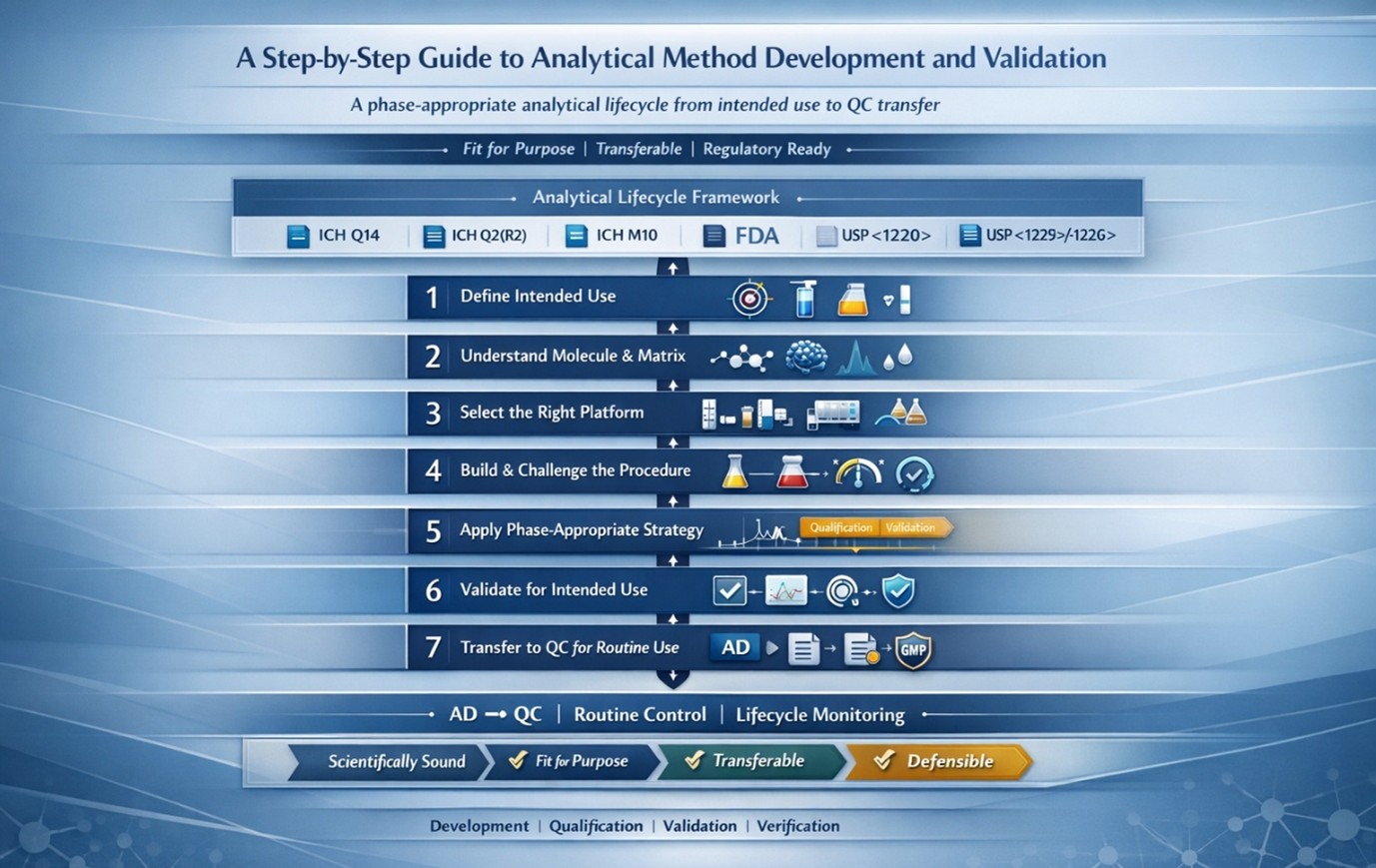
Step 1: Define intended use before defining conditions
No method can be judged effective until its purpose is stated clearly. Under International Council for Harmonisation (ICH) Q14, that purpose is often framed through an Analytical Target Profile (ATP). Whether or not the team formally uses that term, the principle is the same: define what must be measured, in which sample, across what range, and with what performance expectations. Many method failures are not technical failures at all. They are purpose failures created at the beginning, when the team never aligned on whether the method was intended for release, stability, characterization, in-process control, or bioanalysis.
Step 2: Understand the molecule, the matrix, and the likely failure modes
The analyte and the sample should shape the method from the first day of development. For small molecules, that usually means understanding solubility, pKa, likely degradation pathways, impurity risk, and excipient interactions. For biologics, the focus may shift toward aggregation, fragmentation, oxidation, deamidation, charge heterogeneity, glycoform distribution, or potency drift. For bioanalytical procedures, the matrix is not a background detail. It is part of the method itself. If a stability-indicating procedure is required, forced degradation or stress testing should also begin early enough to show whether the method can truly distinguish degradants from the target signal or in comparison with a reference standard.
Step 3: Choose the analytical platform for the question being asked
A common mistake in analytical method development is to choose the platform first and then force the problem to fit the tool. Good development works in the opposite direction. High-performance liquid chromatography (HPLC) is often appropriate for assay, impurity profiling, and related-substance separation. Preparative HPLC method development serves a different purpose, where recovery and fraction purity may matter more than routine quantitation. Liquid chromatography-mass spectrometry (LC-MS) method development becomes important when higher selectivity, lower detection limits, structural confirmation, or complex matrices are involved. In regulated bioanalysis, liquid chromatography-tandem mass spectrometry (LC-MS/MS) is often the correct platform because it offers the sensitivity and specificity needed for low-level quantitation in biological matrices. For biologics, imaged capillary isoelectric focusing (icIEF) may be the direct answer when charge heterogeneity is the real quality question. For adeno-associated virus (AAV) programs, one platform is rarely enough.
Step 4: Build the procedure deliberately and challenge it under realistic conditions
Once the platform is selected, the real development work begins. For chromatographic procedures, this usually includes column chemistry, mobile phase composition, pH, gradient design, diluent compatibility, temperature, and detector settings. For LC-MS work, internal standard strategy, extraction recovery, ionization conditions, carryover control, and calibration design should be addressed early. For icIEF, ampholyte range, pI marker selection, capillary conditioning, sample pretreatment, and profile assignment all require control from the start. And the list goes on for other methodologies.
A robust method is not defined by one successful set of conditions. It is defined by understanding which variables matter and how sensitive the result is to change. Analytical development should therefore include realistic challenge work with placebo, matrix blanks, spiked samples, stressed materials, aged samples, and representative lots where appropriate.
Step 5: Be realistic about what is phase-appropriate
One of the most expensive mistakes in method development and validation is treating every procedure as if it already belongs in a commercial control package. Phase-appropriate analytical method validation means aligning the depth of the package with the stage of development and the risk of the decision being made. Early-stage methods often need qualification and a clear demonstration that they are fit for purpose. They do not always need a full commercial-style validation package. As programs move forward, those methods are expected to mature into more structured, better characterized, and ultimately fully validated procedures. That is the practical meaning of phase-appropriate analytical development: not lowering the standard but matching the standard to the regulatory and program risk at that point in time.
Step 6: Validate against actual intended use
Analytical validation is the formal, documented demonstration that the procedure performs as required for its intended purpose. A good validation protocol is not a generic form. It is a structured justification for why the selected studies, sample sets, analysts, instruments, calculations, and acceptance criteria are appropriate for the decision the method will support. Depending on the method type and per ICH Q2(R2) guidelines, method validation parameters may include specificity, accuracy, precision, linearity, range, detection limit, quantitation limit, and robustness. In the case for compendial methods, the question may not be whether the laboratory must fully revalidate the procedure, but whether it must verify that the pharmacopeial method performs as expected at that specific testing site.
Step 7: Transfer the method in a form that Quality Control can routinely execute
Analytical method development does not end when one development scientist can make the procedure work. A method becomes operational only when it can be written clearly, trained consistently, transferred successfully, and executed reliably in the receiving laboratory. That is where the distinction between Analytical Development (AD) and Quality Control (QC) becomes practical rather than theoretical. AD generates the scientific understanding behind the method. QC executes the transferred method in a Good Manufacturing Practice (GMP) environment and produces data that must withstand quality and regulatory scrutiny. A transfer package therefore needs more than the final method text. It should include a transfer protocol, predefined acceptance criteria, system suitability logic, sample preparation clarity, allowable adjustments, data handling rules, and realistic evidence that the receiving laboratory can run the method reproducibly under routine conditions.
How the Development Strategy Changes by Platform & Modality
The framework for analytical method development and validation is consistent, but the technical emphasis changes by platform. For example, HPLC method development, the main issues are often separation quality, diluent compatibility, impurity resolution, detector response, degradation coverage, and system suitability, especially where impurity thresholds drive sensitivity and specificity requirements. Another example is LC-MS method development, where the focus shifts towards extraction, internal standard design, matrix effects, ionization behavior, selectivity, carryover, and calibration performance.
With regards to modality (e.g. biologics, gene therapy, etc.)_ the analytical strategy is broader and more assay-panel driven. For monoclonal antibodies, Imaged Capillary Isoelectric Focusing (icIEF) method development is central when charge heterogeneity is a critical quality attribute whilst peptide mapping by LC-MS/MS may be required for sequence confirmation and variant assessment and Size exclusion chromatography-high performance liquid chromatography (SEC-HPLC) is commonly used for aggregate and fragment monitoring. For AAV gene therapy, as an example, droplet digital polymerase chain reaction (ddPCR) is often part of the vector genome titer strategy for assessment of purity and indirectly potency. In all program modalities, appropriate cell-based potency assays may be needed when biological activity cannot be represented adequately by a binding assay or biochemical assay alone.
Our Final Thoughts on Analytical Method Development and Validation in 2026
Good analytical method development and validation are not about producing a polished protocol for its own sake. They are about building a procedure that answers the right question, performs reliably in the real sample, and remains defensible as the program evolves.
Development explains why the procedure works. Qualification and validation show that it is fit for purpose. Transfer demonstrates that it can survive routine use. Continued monitoring keeps it credible over time. For sponsors, CMC teams, and QC organizations, that is the real value of strong analytical development: not just a method that passes once, but a method that continues to support the program when the stakes are higher. Reach out to DES Pharma for more consulting on the matter.