

TL;DR: Late-stage CMC work and primary packaging design are usually run as separate programs, and that separation is where commercial timelines quietly break. The molecule team defines critical quality attributes, stability behavior, and analytical control strategy; the packaging team selects materials, qualifies container closure systems, and proves the format can be filled at commercial line speeds.
When those two workstreams share data early, extractables and leachables surprises, siliconization failures, and glass delamination findings get caught in development rather than in registration stability. DES Pharma Consulting and Adept Packaging work the problem from both ends: product understanding on one side, container physics and scalability on the other.
The Handoff That Is Not Really a Handoff
By the time a program reaches late-stage chemistry, manufacturing, and controls, most teams believe the hard science is behind them. The formulation is locked, the process is defined, the analytical methods are validated. Packaging, in this view, becomes a procurement exercise: pick a vial, pick a stopper, order the components.
That framing costs programs months and months. A container closure system is not a passive box around the drug product; it is an active participant in the stability profile.
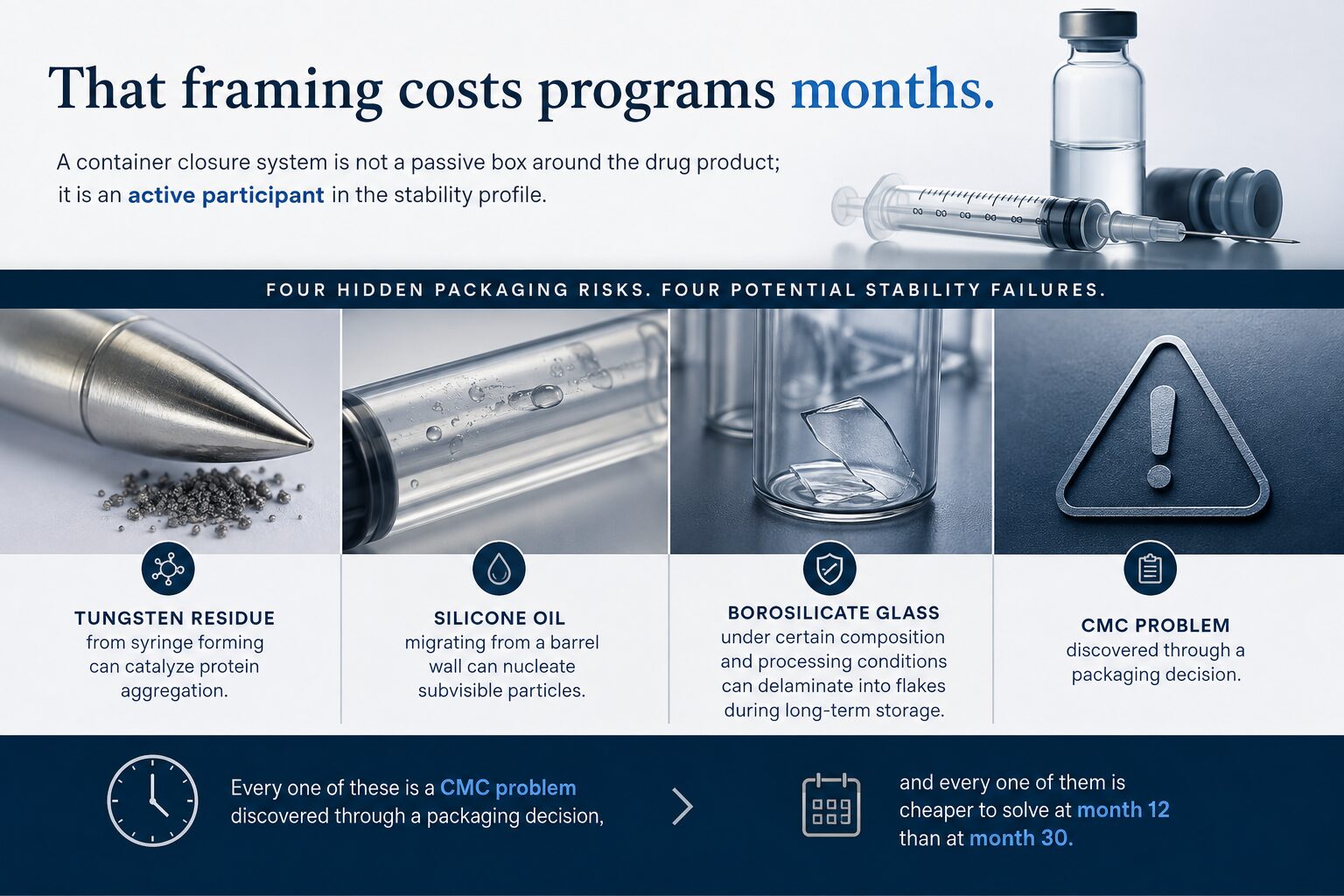
Tungsten residue from syringe forming can catalyze protein aggregation. Silicone oil migrating from a barrel wall can nucleate subvisible particles. Borosilicate glass under certain composition and processing conditions can delaminate into flakes during long-term storage. Every one of these is a CMC problem discovered through a packaging decision, and every one of them is cheaper to solve at month twelve than at month thirty.
The fix is structural rather than heroic: build a shared data model between the people who understand the molecule and the people who understand the container.
What DES Pharma Brings: Defining What Actually Matters
Critical quality attributes as the design brief
Packaging cannot be designed against a vague requirement to keep the product safe. It has to be designed against a specific, ranked list of attributes that the product cannot afford to lose. DES Pharma’s program and process development practice builds that list through structured risk assessment, linking each CQA to its clinical relevance and to the process and storage variables that move it. Aggregation, oxidation, deamidation, particulate burden, pH drift, and delivered dose accuracy each carry a different sensitivity, and each points toward a different packaging constraint.
Once the CQA hierarchy exists, the packaging conversation becomes concrete. A product where oxidation is the dominant degradation pathway needs headspace and barrier strategy. A high-concentration antibody where viscosity and aggregation dominate needs attention to shear during filling and to the silicone interface. The brief writes itself once the science is ordered properly.
Formulation stability under real conditions
Stability programs designed only to satisfy ICH storage conditions will pass while still missing the failure mode that matters. Excipient selection, buffer capacity, surfactant level, and freeze-thaw tolerance all interact with the container surface. Protein adsorption at interfaces is a well-characterized driver of loss and aggregation in biologic formulations, and research groups such as the University of Colorado Boulder have spent years mapping how interfacial stress translates into particle formation. Designing stability studies that deliberately include the intended container, and stress it, is what converts that literature into program-specific knowledge.
Analytical testing that can see the problem
A control strategy is only as good as the methods behind it. Quality control and analytics work at this stage means confirming that methods are stability indicating, that subvisible particle characterization extends below the compendial thresholds, and that trace metal and organic impurity methods have the sensitivity to detect container-derived species at the levels that matter toxicologically. If the assay cannot resolve a leachable at the safety concern threshold, the extractables study that follows will produce false comfort.
What Adept Packaging Brings: Materials and Container Physics
Glass, polymer, and the honest tradeoff
Type I borosilicate glass remains the default for parenterals because of its inertness and its regulatory familiarity. Cyclic olefin polymers offer break resistance, dimensional consistency, lower extractable ion load, and better performance at deep-cold storage, at the cost of higher oxygen and moisture permeability and a shorter regulatory track record. Neither answer is universally correct. The selection depends on the CQA hierarchy that came out of the development work, on the storage temperature, on the delivery route, and on the fill volume.
Adept Packaging’s packaging design and development teams work that decision as an engineering tradeoff with documented rationale, which is exactly what reviewers expect to see rather than a preference asserted after the fact.
Extractables and leachables as a designed study
E&L work fails most often because it is scoped too late and too narrowly. A defensible program starts with a materials inventory covering every product contact surface, applies controlled extraction conditions across relevant solvent polarities, screens with orthogonal techniques, and then runs a leachables study on the actual formulation in the actual container across the intended shelf life. The FDA guidance library sets clear expectations for container closure system data in submissions, and toxicological assessment thresholds determine which identified compounds require qualification. Building this into late-stage CMC rather than bolting it on at registration is the single highest-leverage scheduling decision most programs make.
Scalable container physics
A format that performs beautifully on a laboratory filler can still fail on a commercial line. Glide force and break-loose force in a prefilled syringe shift with siliconization method and with storage time. Stopper compression set governs container closure integrity across the temperature range the product will actually see. Dimensional tolerance stack-up across nest and tub determines whether a machine runs at rated speed or jams every few hundred units. Work on interfacial and mechanical behavior of pharmaceutical containers at institutions like Rutgers University underlines how much of this is measurable physics rather than trial and error.
Why the Market Rewards Getting This Right Between Late-Stage CMC and Primary Packaging Design
The commercial pull toward self-administered injectables makes the CMC and packaging interface more consequential every year, because the container is now also the delivery device and the patient interface.
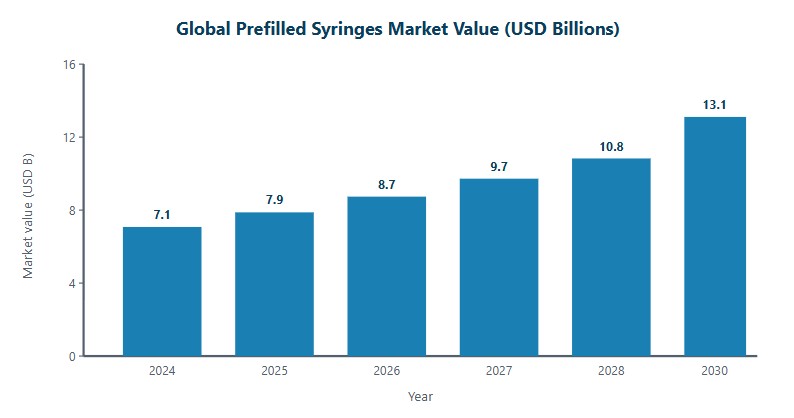
Anchor values for 2024 and 2030 reported by MarketsandMarkets; intermediate years interpolated at the reported 10.8% compound annual growth rate. (Source)
Practical Steps to Close the Gap in 2026
Three habits separate programs that finish cleanly from programs that scramble. First, freeze the CQA hierarchy before the container short list, not after. Second, run stability in the candidate container closure system from the earliest point at which representative components can be obtained, and treat the E&L protocol as a stability deliverable rather than a submission chore. Third, involve line engineering before format lock, because a container that cannot be filled at rate is not a solved problem. Supporting all three requires quality assurance oversight that treats packaging data and product data as one file.
Common Questions:
When should packaging selection begin relative to late-stage CMC work?
Candidate screening should overlap with early Phase 2, and the primary container should be selected before registration stability begins. Selecting later forces either a rushed bridging study or a shelf life claim built on limited data.
How do extractables studies differ from leachables studies?
Extractables studies use exaggerated conditions to identify everything a material can release under stress, creating a screening inventory. Leachables studies measure what actually migrates into the specific formulation under real storage conditions and timeframes. The first scopes the risk; the second quantifies it.
Is cyclic olefin polymer a safe substitute for Type I glass?
It can be, and it is often preferred for deep-cold storage, break resistance, and low extractable ion load. The tradeoffs are higher gas and moisture permeability and a thinner precedent base, so the choice needs to be justified against the product’s specific degradation pathways rather than adopted by default.
What causes glass delamination and how is it detected?
Delamination arises from surface chemistry created during forming and from interaction with certain formulation conditions, particularly high pH and specific buffer species. Detection combines accelerated screening, surface analysis of container interiors, and subvisible particle monitoring across long-term stability.
How much does a partnered approach compress timelines?
Programs vary, but the meaningful saving comes from avoiding late repeat stability. Discovering a container-driven degradation issue after registration stability has started typically costs a full stability cycle. Catching it during development costs a protocol amendment.
Working the Problem From Both Ends
Product understanding without container engineering produces a formulation that cannot be commercialized. Container engineering without product understanding produces a beautifully manufactured package around an unstable drug. The programs that reach the finish line on schedule are the ones where both disciplines are looking at the same dataset from the first stability protocol onward. That is the working model DES Pharma Consulting and Adept Packaging bring to late-stage development.

Matt specializes in Process Development (PD) and Chemistry, Manufacturing, and Controls (CMC) strategy, helping life sciences companies navigate early-stage development, lab innovation, and technical regulatory hurdles.
Reach out to Matt on LinkedIn.