
TL;DR
- Technology transfer and cold chain packaging are usually run by separate teams on separate timelines, and the gap between them is where launch delays start.
- Biologics have accounted for roughly a quarter to a third of CDER novel approvals since 2021, so temperature-controlled distribution is now a mainstream requirement rather than a niche one.
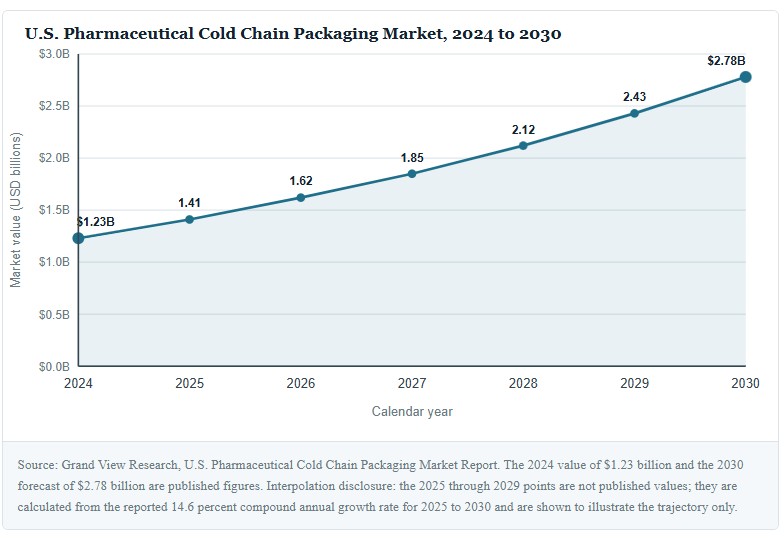
- The U.S. pharmaceutical cold chain packaging market is forecast to grow from $1.23 billion in 2024 to $2.78 billion by 2030, a compound rate of 14.6 percent.
- DES Pharma owns the process, analytical, and quality side of transfer; Adept Packaging owns primary and secondary container design, qualification, and distribution testing.
- The practical fix is a shared checkpoint model: stability and excursion data feed packaging design before the container is locked, not after.
Why Transfer and Packaging Belong in One Plan
Technology transfer is treated as a manufacturing exercise: move a process, reproduce the output, prove comparability. Packaging is treated as a commercial exercise: pick a container, qualify it, ship it. In practice the two are coupled through the same data. Thermal stability limits set at the formulation stage decide how much protection a shipper has to provide. Fill volume and closure geometry decide how a vial behaves during freeze-thaw. Hold times chosen during process fit decide whether a lane needs a 96-hour or a 120-hour shipper.
When those decisions are made in isolation, the correction is expensive. Requalifying a shipping system after a container change can consume an entire quarter, and it lands squarely in the window when a sponsor is least able to absorb it. The FDA’s process validation guidance frames validation as a lifecycle rather than a single event, and packaging sits inside that lifecycle whether a program plans for it or not. The strategic alliance between our two firms exists to close exactly this gap.
What DES Pharma Locks Down Before the First GMP Batch
Transfer readiness is a documentation problem before it is an engineering problem. Our process development team works backward from the receiving site’s equipment train, because a scale-down model that ignores the destination is a model of the wrong process. That means confirming shear profiles, mixing geometry, and filtration capacity against real equipment rather than nominal specifications.
Alongside that, the analytical control strategy has to travel intact. Method transfer failures are a common and avoidable cause of schedule slip: a stability-indicating assay that behaves differently on a different instrument platform will generate comparability questions that take months to resolve. Our quality assurance practice builds the quality agreement, deviation pathways, and batch release logic that hold the transfer together, while supply chain planning confirms that raw materials and single-use components are actually available at the receiving site’s volumes.
One output matters more than any other for packaging: the excursion envelope. How long can this product sit outside its label storage condition, at what temperature, how many times, before quality is affected? That number comes out of stability and forced degradation work, and it is the single input that determines what the container has to do.
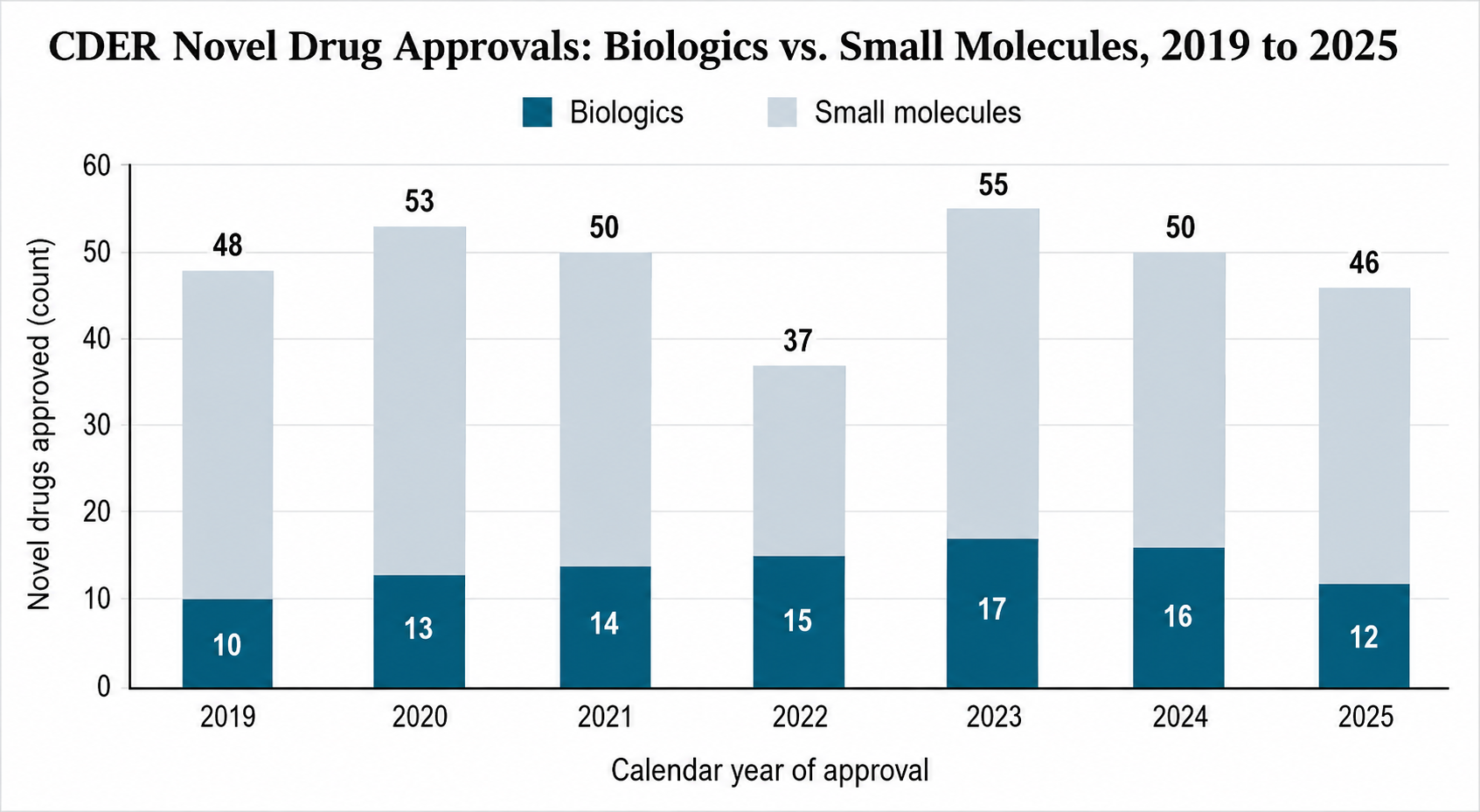
The pattern above is why this briefing exists. Biologics have held between roughly 21 and 41 percent of CDER’s novel approvals across the last seven years, and the modalities behind that share, monoclonal antibodies, recombinant proteins, mRNA products, and cell and gene therapies, are the ones with the narrowest thermal tolerances. Cold chain is no longer an exception path. It is the default path for a large and growing slice of the pipeline.
Where Adept Packaging Designs to the Excursion, Not the Average
Once the excursion envelope is known, packaging becomes a defined engineering problem. Adept’s pharmaceutical packaging engineering teams work from the product’s tolerance rather than from a lane’s typical performance, because typical performance is not what breaks a shipment. A summer tarmac hold, a customs delay, a failed refrigerated unit at a regional depot: these are the events a shipper has to survive, and they define the qualification protocol.
Container selection carries its own consequences. Glass and polymer primary containers respond differently to freezing, and closure integrity at minus 70 degrees Celsius is not the same problem as closure integrity at 5 degrees. Where a program can move to a lyophilized presentation, the distribution picture changes substantially; researchers at Purdue’s lyophilization research group note that freeze drying is used in roughly a quarter of new injectable and biological products precisely because it removes the need for deep-chill transport. That tradeoff, cycle time and capital cost against distribution simplicity, is a joint decision, not a packaging decision.
Secondary and tertiary systems then have to be qualified against real distribution profiles, with thermal mapping, drop and vibration testing, and payload configuration all documented. The discipline behind that testing is the same body of work taught and researched at institutions like Michigan State University’s school of packaging science research, and it is what separates a shipper that passed a summer profile from one that merely looks robust.
A Shared Checkpoint Model
The remedy is not more meetings. It is three checkpoints where both disciplines sign the same document.
DES Pharma owns
Process fit and scale-down modeling, method transfer and comparability, stability and excursion data, quality agreements and deviation pathways, CDMO oversight, and the regulatory narrative that ties the transfer together.
Adept Packaging owns
Primary container and closure selection, packaging design and specification, shipper qualification against seasonal profiles, distribution and drop testing, serialization readiness, and artwork and labeling control.
- Checkpoint one, at process lock: the excursion envelope is issued to packaging before the container is selected.
- Checkpoint two, at engineering batch: packaging qualification runs against material from the receiving site, not from the originating site.
- Checkpoint three, at PPQ: shipping validation and process validation are reported into the same lifecycle file, consistent with the storage and handling expectations set out in warehousing procedures under 21 CFR Part 211.
Failure Modes We See Most Often
Four patterns account for most of the trouble. First, a container change late in development that invalidates completed stability, forcing a restart of the shelf-life clock. Second, shipper qualification run on a surrogate payload that does not match final fill volume, so thermal mass differs in the field. Third, an excursion policy written after launch, which leaves quality with no pre-agreed basis for disposition when the first deviation arrives. Fourth, last-mile handling that is never trained; CDC’s vaccine storage toolkit remains the clearest public illustration of how many failures happen at the receiving end rather than in transit.
None of these are exotic. All of them are cheaper to prevent at process lock than to remediate at launch, which is the entire argument for treating pharma consulting support on transfer and packaging as one engagement rather than two.
Additional Q&A:
When should packaging engineering join a technology transfer project?
At process lock, before the primary container is selected. Once fill volume, closure, and hold times are fixed, packaging is constrained by decisions it had no part in. Bringing packaging in at that point still allows the container and the process to be optimized against each other.
Does a technology transfer require shipping validation to be repeated?
Often yes, at least in part. If the receiving site produces material with a different fill configuration, thermal mass, or presentation, the qualified shipper’s performance can no longer be assumed. The practical test is whether the payload used in the original qualification still represents what will ship.
What is an excursion envelope and who defines it?
It is the documented set of temperature and time conditions a product can tolerate outside label storage without a quality impact, including cumulative and repeat exposures. It is defined by stability, forced degradation, and formulation data, which places it on the development side rather than the logistics side.
Can lyophilization remove the need for cold chain entirely?
Sometimes, and it is worth assessing early. A freeze-dried presentation can shift a product from frozen to refrigerated or ambient distribution, which changes cost and reach considerably. The tradeoff is longer cycle times, capital and capacity constraints, and additional reconstitution steps at the point of care.
How do the two firms divide responsibility on a joint engagement?
DES Pharma leads process, analytical, quality, and supply chain workstreams; Adept Packaging leads container, qualification, distribution testing, and labeling workstreams. The two teams share a single project plan and the three checkpoints described above, so neither side is designing against assumptions the other has already changed.
Planning a transfer with a temperature-sensitive product? DES Pharma Consulting and Adept Packaging run joint readiness reviews that map your excursion data against your intended distribution lanes before the container is locked. Reach out through despharmaconsulting.com or adeptpackaging.com to start the conversation.
Sources
- U.S. Food and Drug Administration, *Process Validation: General Principles and Practices*, January 2011
- U.S. Food and Drug Administration, CDER Novel Drug Approvals for 2025
- National Library of Medicine, PubMed Central, analysis of FDA drug approvals by molecule type, PMC11820978
- Grand View Research, U.S. Pharmaceutical Cold Chain Packaging Market Report, 2030
- Electronic Code of Federal Regulations, 21 CFR 211.142, Warehousing Procedures
- Centers for Disease Control and Prevention, *Vaccine Storage and Handling Toolkit*
- Purdue University, College of Engineering, Advances in Lyophilization, 2024
- Michigan State University, School of Packaging

Senior Consultant, Process Development & CMC