
For many oncology programs, dose escalation used to have a familiar stopping point: find the maximum tolerated dose, select a dose at or near that level, and move into expansion. That logic is no longer enough for many modern cancer drugs. FDA’s August 2024 final guidance on dosage optimization asks sponsors to justify the dosage intended for later development using the full body of available clinical and nonclinical evidence, not simply the highest dose patients could tolerate during escalation.
That change matters for antibody-drug conjugates because an ADC does not behave like a single uniform molecule in circulation. The antibody, the conjugated species, unconjugated antibody, released payload, and active payload metabolites may contribute different information about activity and toxicity. Product attributes such as drug-to-antibody ratio, or DAR, can also shift with manufacturing changes. A dose decision made from clinical tolerability alone can therefore miss changes in exposure that are tied to the material itself.
A 2026 review of 12 FDA-approved ADCs found that five programs carried the maximum tolerated dose forward as both the recommended Phase 2 dose and the Phase 3 dose. That finding is useful context, but it should not be read as a rule for ADC development. The regulatory direction is moving toward a more complete dosage argument, especially at the point where a program leaves escalation and begins the Phase 2 work that will shape a registration strategy.
Why the MTD Can Be the Wrong Answer
The maximum tolerated dose answers a narrow question: what dose can be administered within the toxicity rules of a particular escalation design? It does not automatically identify the dose with the most favorable balance of activity, safety, tolerability, and long-term treatment feasibility.
That distinction is particularly relevant for ADCs. Higher exposure can increase target engagement and payload delivery, but it can also increase payload-related toxicity, dose interruptions, dose reductions, and treatment discontinuation. If activity begins to plateau before toxicity does, moving to the MTD can add burden without adding enough clinical value to justify it. The same problem can appear when cumulative toxicity is not fully visible during the short observation window used for dose-limiting toxicity assessment.
FDA’s 2024 dosage optimization guidance addresses this directly. Sponsors are expected to compare more than one dosage when needed to characterize dose and exposure relationships for activity, safety, and tolerability. FDA recommends randomized, parallel dose-response studies when appropriate because randomization reduces selection bias and makes cross-dose comparisons easier to interpret. The trial does not have to be powered as a formal superiority or non-inferiority study. It does, however, need to generate enough information to support the dosage that will move forward.
What FDA Expects Before Phase 2
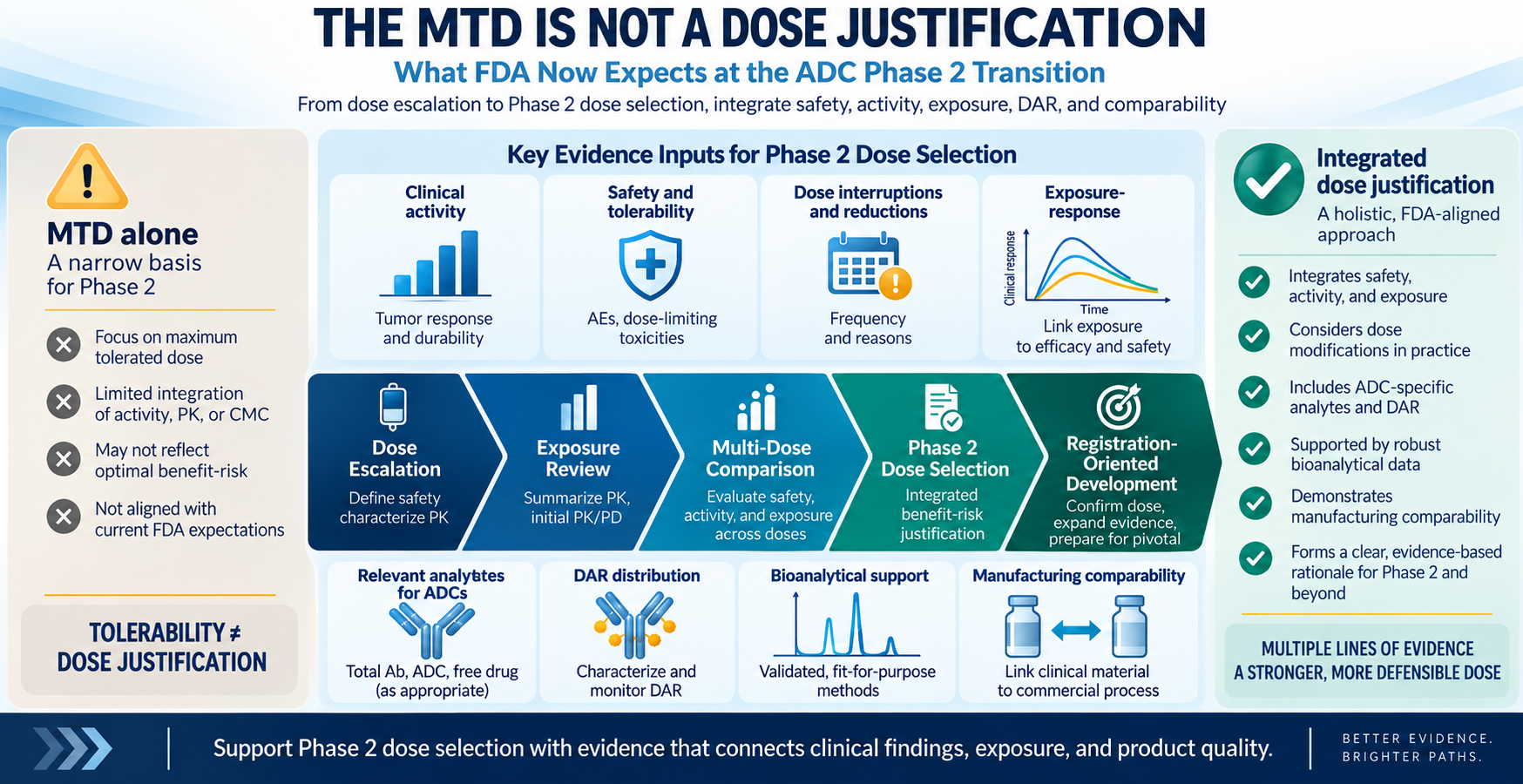
The practical implication is that Phase 2 dose selection should be treated as a development decision with its own evidence package. The sponsor should be able to explain which doses were compared, what was learned about efficacy and toxicity across those doses, how exposure changed, and why the selected schedule is suitable for continued development.
An expedited development program is not, by itself, a reason to skip this work. FDA’s final guidance states that participation in an expedited program does not provide sufficient justification for avoiding dosage optimization. Manufacturing difficulty is also not a sufficient reason to study only one dosage. For ADC teams, that point can be uncomfortable because multiple dose strengths, more clinical material, and additional analytical support can add pressure to an already complex supply plan. The answer is to plan the comparison earlier, not to assume the MTD will be accepted as the final dose argument.
The dosage discussion should begin while escalation data are still accumulating. Clinical pharmacology, clinical development, CMC, biostatistics, safety, and manufacturing teams should agree on what evidence will be needed before the Phase 2 protocol is locked. Waiting until the end of escalation makes it much harder to separate a clinical dose question from a product-quality question.
An ADC Does Not Have One Exposure
FDA’s March 2024 final guidance on clinical pharmacology considerations for ADCs reflects the fact that several analytes may be relevant to the exposure story. Depending on the product, that can include the conjugated ADC, total antibody, unconjugated antibody, unconjugated payload, and active payload metabolites. Exposure-response analyses should consider the components that are capable of explaining the observed clinical findings.
This matters when two patients receive the same nominal ADC dose but experience different systemic exposures to the conjugate or the released payload. It also matters when two clinical lots meet the same average DAR target but contain different proportions of highly loaded or lightly loaded species. A dose level on the case report form tells only part of the story. The sponsor also needs to know what material was administered and what patients were exposed to after administration.
Bioanalytical methods therefore belong in the dose-selection plan from the first-in-human stage. FDA points sponsor to ICH M10 for bioanalytical method validation and study sample analysis. If a program proposes not to measure a relevant analyte, the rationale should come from data showing why that analyte is unlikely to add useful information, not from convenience alone.
Which Analytes Need to Stay in the Plan?
The exact analyte panel will differ by ADC, but several principles are useful. Unconjugated payload should be measured with enough sensitivity to detect clinically meaningful changes in systemic exposure. Total antibody can sometimes add little information when it tracks very closely with the conjugated antibody, but that relationship should be demonstrated rather than assumed. Target biology can also complicate interpretation when shed antigen or target binding changes what the assay is actually measuring.
The key is to make the analytical strategy answer the clinical question. If toxicity appears to rise without a similar increase in conjugate exposure, free payload or an active metabolite may be more informative. If activity differs across dose levels while nominal dose is similar, exposure to the conjugate and the shape of the DAR distribution may need closer review. Anti-drug antibodies can also contribute to unexpected exposure patterns and should be considered when the pharmacokinetic profile changes in ways the manufacturing data do not explain.
A useful Phase 2 package does not collect every possible assay simply because it can. It retains the measurements needed to explain why one dose performs differently from another.
DAR Is a Distribution, Not Just an Average
Average DAR is convenient because it reduces a heterogeneous population to one number. That number can still hide product differences that matter. Two ADC lots can report the same average DAR while containing different fractions of unconjugated antibody, low-load species, and high-load species. Those fractions can differ in hydrophobicity, clearance, potency, and tolerability.
Preclinical work illustrates why that distinction deserves attention. In a widely cited mouse study, purified ADC species with higher drug loading showed faster plasma clearance and lower tolerated doses than lower-load species. Reducing the number of drugs per antibody increased the therapeutic index in that model. The finding is preclinical and should not be presented as a clinical rule, but it demonstrates that drug loading can change pharmacokinetics and tolerability even when the antibody target is unchanged.
Analytical method choice can also influence the reported DAR value. Peer-reviewed comparisons have shown that mass spectrometric and ultraviolet-based approaches can produce different estimates because highly hydrophobic drug-loaded species may not be represented identically by every method. Regulators have not turned that observation into a universal requirement. It does mean that teams should understand what their DAR method measures and whether the same method and data treatment are being used when lots are compared.
Manufacturing Changes Can Break the Clinical Bridge
The Phase 2 transition is often when manufacturing starts changing. Conjugation may move to a different scale, a different site, a new equipment train, or a modified purification process. These changes can be necessary for supply and commercialization, but they can complicate the dose argument if the material used in escalation is not sufficiently comparable with the material used for randomized dose evaluation.
ICH Q5E provides the central comparability principles for biotechnology and biological products after manufacturing process changes. Its purpose is to determine whether the change has altered product quality in a way that could affect safety or efficacy. For an ADC, the assessment may need to look beyond average DAR to the distribution of loaded species, free payload, aggregates, unconjugated antibody, potency, and other attributes linked to the specific process change.
A comparison that shows the same average DAR has not automatically shown the same DAR distribution. The acceptance criteria used during development determine whether that distribution was ever being controlled in the first place. Teams should also be careful with ICH Q6B at this stage. Q6B is highly useful for thinking about biologic product characterization and specifications, but its stated scope does not include preclinical and clinical research material. It should not be cited as though it creates investigational-stage specification requirements that it does not claim to set.
What a Phase 2 Dose Justification Should Bring Together
Before the Phase 2 protocol is finalized, the dose package should be able to connect six pieces of evidence:
- Clinical activity across the dose levels and schedules that were actually studied
- Safety, tolerability, dose interruptions, dose reductions, and cumulative toxicity
- Pharmacokinetic and exposure-response data for the ADC components that matter to the product
- Bioanalytical evidence showing that the relevant analytes were measured with suitable methods
- CMC comparability data when the Phase 2 material differs from the escalation material
- A product-quality assessment that considers DAR distribution and other process-sensitive attributes, not only nominal dose
Planning the Phase 2 Transition
The regulatory edge of this issue should not be overstated, but it should not be ignored. Under 21 CFR 312.42, FDA can place a Phase 2 or Phase 3 study on clinical hold when FDA finds the plan or protocol deficient in design to meet its stated objectives. FDA’s 2024 dosage guidance also states that a dosage selected without adequate justification or without consideration of relevant data may be unacceptable because it can create subject risk or leave the agency without enough information to assess that risk.
The practical lesson is not that every ADC must run the same dose optimization trial. It is that the program should be able to show why its design can answer the dose question it has created. The clinical team needs CMC context to know whether exposure differences reflect dose or product. The CMC team needs clinical context to know which product attributes matter to the decision. Those two threads should be connected before Phase 2 starts, not after an agency question arrives.
Partner with DES Pharma Consulting
DES Pharma Consulting supports ADC sponsors with integrated CMC and clinical development planning at the Phase 2 transition, including dose-justification strategy, bioanalytical planning, comparability assessment, product-quality review, and cross-functional readiness for FDA interaction. If your program is moving from escalation into dose optimization or expansion, DES is your ideal pharma consulting partner that can help build the clinical and CMC evidence into one dose argument before the Phase 2 protocol is finalized.

Senior Consultant, Process Development & CMC