
The first-in-human submission for an antibody-drug conjugate is where several development programs have to meet at the same time. The antibody intermediate has its own manufacturing history. The linker-payload has a separate synthesis and impurity story.
Conjugation creates a heterogeneous biological product with new quality attributes. The clinical protocol then asks regulators to accept a starting dose and escalation plan before the sponsor has commercial-scale experience with any of it.
That does not mean an ADC IND needs a commercial package on day one. FDA’s IND regulations are phase-appropriate by design, and Phase 1 manufacturing has more flexibility than later development. It does mean that the submission needs enough information to let FDA assess whether the proposed trial can proceed without exposing subjects to an unreasonable and significant risk.
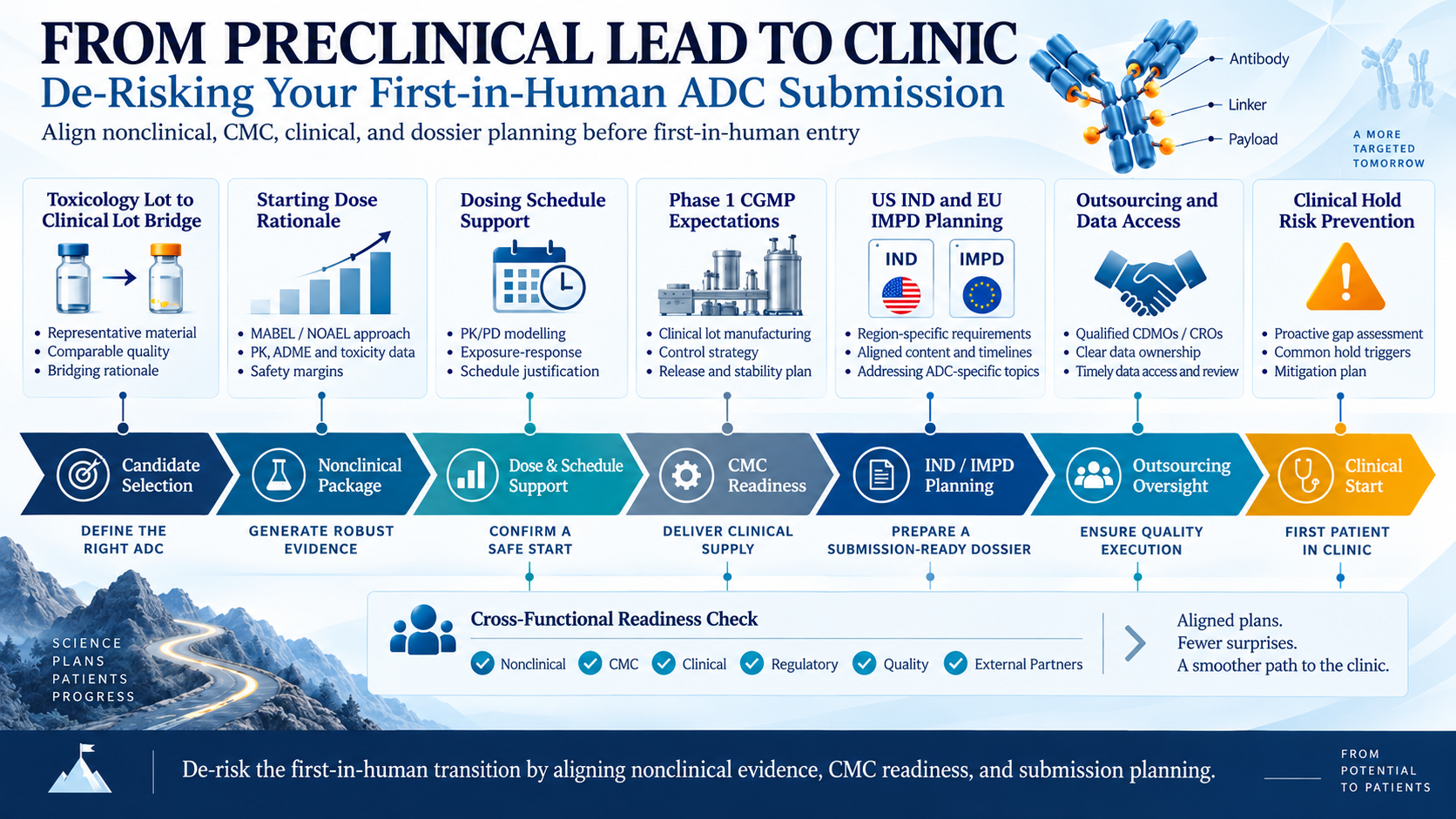
The best way to de-risk that point is to build the first-in-human package backward from the dosing date. Nonclinical strategy, clinical pharmacology, CMC, manufacturing, bioanalysis, and regulatory interactions should be scheduled around the same question: what evidence must exist before the first patient receives the ADC?
An ADC IND Has More Than One Manufacturing Story
Under 21 CFR 312.23, an IND must provide chemistry, manufacturing, and controls information for the investigational drug that is appropriate to the phase and sufficient for FDA to assess the proposed study. For an ADC, the CMC story often includes the antibody intermediate, linker-payload or payload components, conjugation, purification, formulated drug product, analytical controls, stability, and the sites responsible for each step.
The regulatory classification can add another layer. FDA has listed a cytotoxic agent-monoclonal antibody conjugate for cancer treatment among combination products assigned to CDER with a drug primary mode of action.
That does not mean every ADC program should be described with one universal application type or jurisdiction statement. It does mean teams should resolve product classification and lead-center questions early enough that the IND package, meeting strategy, and manufacturing references are built for the correct review path.
The submission should make it easy for a reviewer to understand where each constituent comes from, how the final conjugate is made, which tests control the material, and how the clinical lot relates to the nonclinical lots that support the proposed trial.
Build the FIH Timeline Backward
FDA finalized its updated guidance on formal PDUFA meetings in August 2026. For an ADC sponsor, a pre-IND meeting can be a useful point to resolve questions about the nonclinical package, CMC maturity, bioanalytical strategy, and the first-in-human design before the submission is locked. The meeting is most useful when the sponsor asks narrow questions backed by enough data for FDA to respond meaningfully.
The internal timeline should therefore start with the planned first-patient-in date and move backward through IND submission, the 30-day IND review period, meeting preparation, toxicology completion, analytical qualification, drug-product release, stability pull points, and manufacturing lead times.
If a linker-payload supplier or antibody manufacturer controls a needed report, certificate, or analytical record, that dependency belongs on the same schedule.
Fast Track designation or another expedited program may increase opportunities for interaction or change review mechanics, but it does not lower the CMC standard needed to protect subjects. A compressed development calendar is a reason to coordinate earlier, not a reason to leave technical gaps unresolved.
What the Nonclinical Package Needs to Answer
ICH S9 and its question-and-answer document provide specific direction for oncology ADCs. The starting dose can be derived using the standard oncology approaches described for cytotoxic products, including fractions of the rodent STD10 or nonrodent HNSTD with body surface area scaling, when those approaches are appropriate for the product and the sensitive species.
Novel ADCs may require a different rationale, but the starting-dose argument should still connect the relevant toxicity findings to the proposed clinical exposure.
The same Q&A also keeps the nonclinical program focused. Separate GLP studies of the monoclonal antibody alone are generally not warranted. Evaluation of the linker alone is also usually unnecessary.
If the payload or linker-payload toxicity has already been characterized in pilot work, a separate GLP study may not add value. If it has not been characterized, a standalone arm or study in one species can be considered.
Toxicokinetic work should measure the ADC and payload and provide an estimate of free antibody. In vitro plasma-stability data in human plasma and the toxicology species should be available before first-in-human dosing. FDA’s S9 Q&A also notes that tissue-distribution studies are generally not warranted for ADCs.
When the target epitope is not present in a relevant nonclinical species, one-species toxicology may be sufficient in some cases instead of forcing an artificial model that does not improve interpretation.
The Dosing Schedule Needs Nonclinical Support Too
The first dose is not the only part of the schedule that needs support. ICH S9 Q&A recommends that at least two doses of the ADC be administered in the toxicology study when the initial clinical regimen uses intervals such as every three or four weeks. The purpose is to observe the consequences of repeat exposure before patients enter a repeated-dose trial.
That evidence should be read alongside the ADC’s plasma stability, payload exposure, target biology, and expected recovery from treatment-related toxicity. A sponsor should not force a standard schedule onto the molecule simply because another ADC used it. The nonclinical data should support both the proposed starting dose and the planned interval between doses.
Phase 1 CGMP Is Flexible, Not Optional
A common misunderstanding is that Phase 1 material is exempt from CGMP. The actual rule is narrower. Under 21 CFR 210.2(c), most investigational drugs manufactured for use in Phase 1 studies are exempt from the specific requirements of Part 211. They remain subject to the statutory CGMP requirement under the Federal Food, Drug, and Cosmetic Act, and FDA’s 2008 Phase 1 CGMP guidance describes the quality controls expected to protect trial subjects.
For an ADC, those controls should fit the product risk. The program still needs suitable control of raw materials, manufacturing records, equipment, contamination risks, analytical methods, release decisions, and stability. The Phase 1 approach can be scaled to the limited manufacturing history available, but it should not be improvised.
The Part 211 exemption also does not travel indefinitely with the product. As material is manufactured for Phase 2 and Phase 3 studies, the development program moves into the broader CGMP framework expected for later-phase investigational drugs. Planning that transition before the next campaign avoids rebuilding the quality system under schedule pressure.
The US IND and EU IMPD Need Separate Planning
A global first-in-human program often requires a US IND and an EU clinical trial application with an Investigational Medicinal Product Dossier. The technical content overlaps, but the dossiers should not be treated as copies of one another. EMA’s current Revision 2 guideline for biological investigational medicinal products, effective since January 2022, sets specific expectations for quality documentation in the IMPD.
The practical issue is timing. A manufacturing change, new analytical method, revised specification, or stability update may need to be reflected differently across regions. Teams should map the common source data once, then maintain region-specific submission logic rather than letting two dossiers evolve separately without reconciliation.
That becomes especially important when the antibody intermediate or linker-payload information is controlled by an external supplier.
Outsourcing Creates a Data-Access Problem
ADC programs often rely on several external manufacturers. That makes document access as important as physical supply. FDA’s CBER SOPP 8301, effective May 7, 2026, shows why sponsors should not assume that a reference arrangement used during an IND will automatically remain available at licensure.
For products submitted under section 351, a BLA generally cannot incorporate drug-substance, drug-substance-intermediate, or drug-product information by reference to a master file except for specific regulatory exceptions. The exact implication depends on the eventual application pathway for the product.
A sponsor can therefore reach first-in-human development with an acceptable reference arrangement and still face a later filing problem if it never negotiated access to the underlying CMC data.
For an ADC with outsourced antibody production, payload synthesis, or conjugation, data-rights planning should begin before the first major contract is signed. The first-in-human IND is not the last time those records will be needed, and the marketing application pathway should be considered when those rights are negotiated.
How CMC Deficiencies Become Clinical Hold Risk
The regulatory threshold at first-in-human entry is straightforward. Under 21 CFR 312.42, FDA can place a Phase 1 study on clinical hold if the IND does not contain sufficient information required under 21 CFR 312.23 to assess risks to subjects. FDA ordinarily attempts to discuss and resolve a deficiency with the sponsor before imposing a hold unless patients face an immediate and serious risk.
A CMC gap becomes clinically important when it prevents FDA from understanding what is being administered or whether the material can be manufactured and controlled in a way that protects subjects. Missing impurity information, unsupported stability, an unresolved change between toxicology and clinical material, or inadequate release controls can all matter because they undermine the risk assessment, not simply because a document is absent.
If a study is placed on hold and the sponsor submits a written request to remove the hold with a complete response to the identified issues, FDA must respond in writing within 30 calendar days. That clock is useful, but avoiding the hold is far better than building the first clinical campaign around a remediation timeline.
A Practical First-in-Human Readiness Check
Before the IND is submitted, the program should be able to answer five questions without relying on future work that has not been scheduled:
- Is the nonclinical package sufficient to support the starting dose, schedule, and proposed clinical monitoring?
- Does the CMC section explain the antibody, linker-payload, conjugation process, final drug product, release tests, and stability at the level needed for Phase 1?
- Is the toxicology lots and clinical lots bridged well enough to support the safety interpretation?
- Are external supplier records, master-file references, and data-access rights available when the submission needs them?
- Have US and EU dossier requirements been mapped separately for the regions included in the first-in-human plan?
Partner with DES Pharma Consulting
DES Pharma Consulting supports ADC sponsors preparing for first-in-human development with CMC strategy, pre-IND meeting preparation, nonclinical and clinical interface planning, manufacturing readiness, comparability assessment, and IND quality-section support. If your program is moving from preclinical lead selection into the clinic, DES can provide the right pharma consulting help identify the gaps that matter before the IND review clock starts.

Senior Consultant, Process Development & CMC