
ADC manufacturing is often outsourced because few sponsors own every capability needed to make the product. The antibody may come from one site, the linker-payload from another, conjugation from a specialist facility, and fill-finish from a fourth partner. Analytical release may be split again across internal and external laboratories.
Each organization can execute its own scope well and the program can still miss the patient dosing date.
The reason is simple: clinical supply is controlled by the interfaces. A payload release delay can cause the conjugation slot to be missed. A conjugation delay can push fill-finish into a later campaign. A method transfer issue at the receiving laboratory can hold disposition after the material has already been manufactured. The sponsor is usually the only party with a view across all of those dependencies.
Predicting stockouts therefore requires more than a purchase-order tracker. It requires a supply model that starts with the patient dosing schedule, works backward through release and manufacturing, and makes time, testing, quality decisions, and contract responsibilities visible before a disruption occurs.
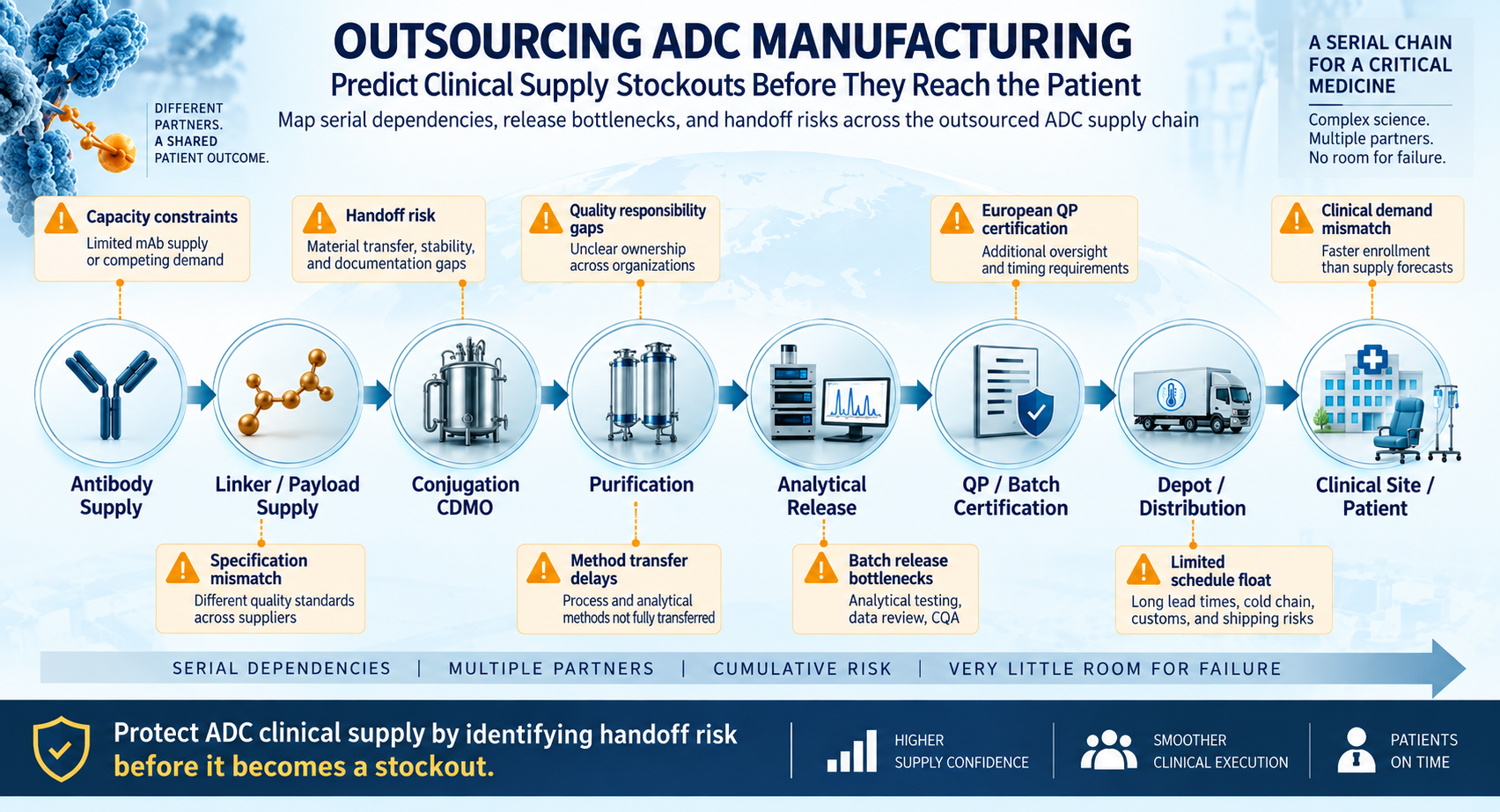
Why ADC Supply Fails at the Handoffs
A conventional biologics program can already have a complicated external network. ADCs add a second chemistry supply chain to the antibody supply chain and then join them at conjugation. That creates serial dependencies that are difficult to recover once a critical date slip.
A linker-payload batch cannot always be replaced quickly because the material may have a long synthesis and release cycle. Antibody intermediate may have its own manufacturing campaign and hold-time limitations. Conjugation facilities often operate specialized contained suites with limited scheduling flexibility. Fill-finish may be booked months ahead. The program can carry enough material on paper and still have no usable clinical drug product at the site when enrollment opens.
The first step is to map the chain as a sequence of release-to-use decisions, not just manufacturing dates. Each node should show what must be complete before the next node can begin, who owns the decision, how long the work usually takes, and what happens if it slips.
Serial Dependencies Leave Little Schedule Float
ADC networks are especially exposed to missed windows because many steps cannot run in parallel. Conjugation cannot start until the required antibody and linker-payload are available and released. Fill-finish cannot proceed until drug substance is manufactured, tested, and accepted for the next operation. Clinical distribution cannot start until final disposition is complete.
A short upstream delay can therefore create a much larger downstream delay when it causes the program to lose a reserved manufacturing slot.
The exact impact depends on the CDMO calendar, material availability, test turnaround, and the ability to reschedule. It is better to model that risk explicitly than to promise a fixed conversion such as a two-week delay becoming a three-month delay in every case.
A useful supply plan shows the true critical path and the available schedule float at each handoff. When the float approaches zero, the team can make a decision before the patient schedule is affected, for example by protecting a backup slot, moving a test earlier, qualifying an alternate laboratory, or adjusting enrollment timing.
Quality Responsibility Does Not Move with the Purchase Order
Outsourcing changes who perform the work. It does not allow a sponsor or product owner to delegate away its regulatory responsibilities. FDA’s final 2016 guidance on quality agreements states that quality agreements cannot be used to delegate statutory or regulatory responsibilities to comply with CGMP.
The agreement should define which party performs specific manufacturing and quality activities, how changes are communicated, and who has approval authority for key decisions.
For the EU, Chapter 7 of the GMP Guide makes the same operating principle visible from the contract giver side. Outsourced activities should be defined, agreed, and controlled through a written contract. The contract giver’s pharmaceutical quality system should control and review the outsourced activity and monitor the contract acceptor’s performance.
For an ADC sponsor, that means a contract should not merely say that a CDMO is responsible for manufacturing, testing, or release. The sponsor needs enough access to deviations, changes, investigations, test results, and batch records to make the decisions that remain its responsibility. The quality agreement should match the actual supply chain, including subcontracted testing and material suppliers that can affect disposition. It goes without saying that supply chain challenges cannot be ignored.
Method and Specification Mismatch Can Stop Release
One of the least visible stockout risks appears after the batch is made. A sending laboratory and a receiving laboratory may use different sample preparation, system suitability rules, reference standards, or data treatment.
The same can happen when the contract specification does not match the version used by the release site. The batch then enters an OOS or atypical-result pathway even though the underlying product may not have changed.
ADC programs are exposed to this because release often relies on several product-specific attributes. Depending on the molecule and stage, the panel may include DAR distribution, free payload, aggregates, unconjugated antibody, potency, identity, sterility, endotoxin, or other microbiological tests.
Every method does not need to sit at one laboratory, but the handoffs need to be planned and transferred before the lot reaches the release queue.
Method transfer is therefore a supply-chain activity as well as an analytical activity. The schedule should include protocol approval, reference-standard availability, analyst training, transfer runs, data review, and any regional requirements that must be complete before routine testing starts.
Build the Supply Plan Backward from the Patient
The most useful forecast begins with the clinical dosing calendar. For each planned cohort or site activation, work backward through shipment, final disposition, analytical release, fill-finish, drug-substance release, conjugation, antibody availability, and linker-payload availability.
Add realistic time for deviations, document review, and quality decisions rather than assuming every step closes on the date the laboratory result is generated.
For EU supply, Qualified Person certification belongs on that path. Regulation (EU) No 536/2014 requires the Qualified Person to ensure that each batch of investigational medicinal product manufactured in or imported into the Union complies with the applicable requirements and to certify that those requirements are fulfilled.
QP certification therefore needs the required manufacturing and quality evidence before the batch can move into the next stage of EU clinical supply.
The forecast should also separate inventory from usable inventory. A vial in quarantine, a batch awaiting QP certification, or linker-payload that has not passed release does not protect the next dosing date. The plan should show when material becomes usable for the next operation, not only when it physically exists.
6 Things to Ask Before Choosing an ADC CDMO
Technical capability is only one part of CDMO selection. The sponsor also needs to understand how the facility manages the schedule and communicates when the plan changes. Several questions are worth answering before a slot is booked:
- Does the site have experience with the required containment and ADC process, not just general biologics manufacturing?
- How are deviations, atypical results, and change controls communicated to the sponsor, and how quickly can the sponsor access the supporting records?
- What capacity is actually protected for the program, and what happens if a preceding campaign runs late?
- Are analytical methods, specifications, reference standards, and sample-shipment routes ready before the first GMP batch?
- Can the sponsor place technical personnel on site when transfer, engineering runs, or investigation support requires direct observation?
- Which activities are subcontracted, and does the sponsor have approval and visibility before those subcontractors’ change?
Europe Adds QP Certification to the Critical Path
Global supply plans often fail when US and EU release pathways are treated as interchangeable. In the EU, QP certification is a distinct legal step for investigational medicinal product batches manufactured in or imported into the Union. The batch cannot simply be released from the manufacturing site’s quality unit and assumed to be ready for trial use.
That makes document availability part of supply readiness. A late certificate, unresolved deviation, missing manufacturing statement, or change that has not been assessed can hold the QP package even when the physical vials are already in the depot. The QP timeline should be built into the forecast from the beginning and supported by document expectations agreed with the manufacturing and packaging sites.
When a Supply Gap Becomes a Regulatory Problem
Most clinical supply disruptions are operational problems first. They should not be described as clinical holds unless FDA has actually issued a hold. A sponsor may manage a short disruption through site scheduling, enrollment pacing, or a protocol amendment depending on the circumstances. The regulatory consequence depends on why the supply failed and whether the failure affects the ability to protect subjects or conduct the study as described.
The distinction matters because FDA’s clinical hold regulation reaches situations where an IND lacks sufficient information to assess risk to subjects. FDA can also propose termination of an IND when manufacturing methods, facilities, and controls are inadequate to establish and maintain the identity, strength, quality, and purity needed for subject safety. Those are different outcomes from a commercial scheduling problem and should not be collapsed into one label.
The sponsor should also avoid importing the rules for approved drug shortages into investigational supply. The statutory shortage notification framework under section 506C applies to specified marketed products, not to an ordinary investigational IND supply interruption. Clinical supply still requires active management, but the regulatory tools are not identical.
Predicting the Stockout Before It Happens
A useful ADC supply dashboard should make five things visible at the same time: demand by patient and cohort, usable inventory by location, the manufacturing and release critical path, unresolved quality events, and the next decision date. That view is more useful than a monthly inventory total because it shows whether the material can actually reach the patient when the protocol requires it.
The sponsor does not need to control every facility to control the network. It does need contracts, quality agreements, governance, and data flows that let it see problems early enough to act. The earlier those interfaces are designed, the less likely a routine delay at one vendor is to become a missed treatment window at a clinical site.
Partner with DES Pharma Consulting
DES Pharma Consulting supports ADC sponsors with outsourced manufacturing strategy, CDMO selection, supply network mapping, quality agreement development, analytical handoff planning, clinical supply forecasting, and issue escalation across complex external networks.
If your ADC program depends on several manufacturing and testing partners, DES will provide reliable pharma consulting to help build a supply model that identifies the next stockout risk before it reaches the patient.

Senior Consultant, Process Development & CMC