
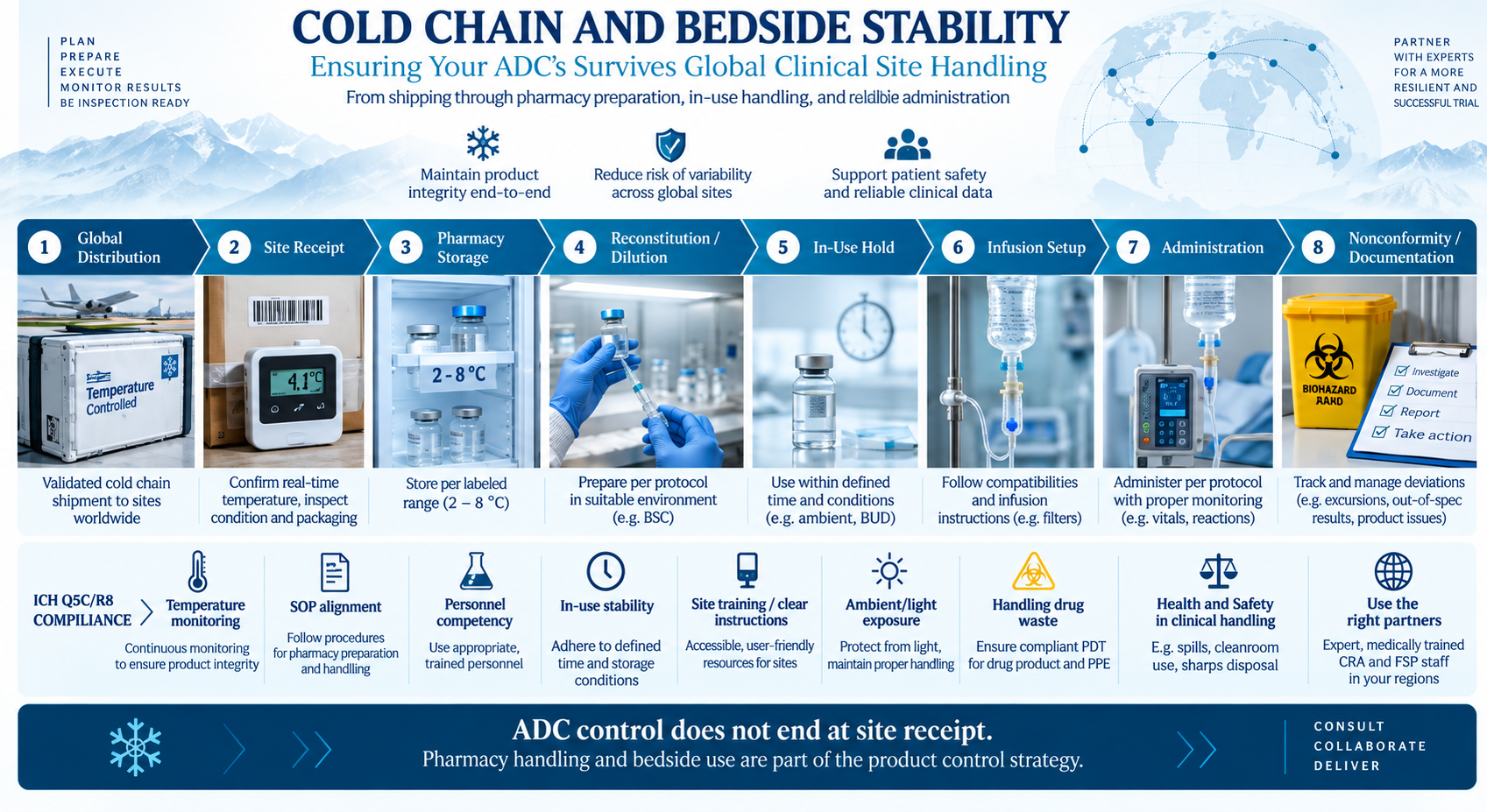
For an investigational ADC, the cold chain does not end when a depot delivers a shipment to the clinical site. The product still has to be received, stored, prepared, diluted, held, transported within the hospital, and administered through a compatible infusion setup.
Each of those steps can change the condition of the product before it reaches the patient.
The site also has to manage two other realities at the same time. Many ADCs require hazardous-drug handling because of the cytotoxic payload, and investigational products do not come with the same commercial package insert and pharmacy history that staff may already know from an approved drug.
The site works from the trial label, the pharmacy manual, the protocol, and sponsor instructions.
That makes bedside stability a sponsor responsibility long before a pharmacist opens the vial. The sponsor needs data that support the reconstitution, dilution, hold, container, infusion set, and handling instructions that the site is expected to follow. If those instructions are vague, product can be quarantined or discarded even when it has not actually degraded, simply because no one can defend what happened to it.
The Cold Chain Does Not End at Site Receipt
The receiving pharmacy inherits a storage envelope that was defined upstream. In the EU, Regulation (EU) No 536/2014 sets detailed labeling particulars for investigational medicinal products, including directions for use, storage conditions, and period of use.
A 2022 amendment allows the period of use to be omitted from immediate packaging in defined cases, such as when immediate and outer packaging remain together or when small immediate containers are used, while the outer package carries the required information.
The US does not use the same Annex VI particulars list for investigational labeling. That puts more weight on sponsor-controlled instructions, site manuals, protocol language, and pharmacy procedures. The practical question at receipt is whether the shipment arrived within its defined conditions and whether the evidence is sufficient to authorize use.
Not every brief movement outside a nominal refrigerator range is automatically a product failure. The site should follow the study’s instructions for temperature monitoring and excursion handling.
When there is uncertainty about the shipment condition, quarantine pending sponsor assessment is often the prudent operating step if the governing documents require sponsor authorization.
The key is not to turn every handling event into a regulatory conclusion. The decision should follow the product data and the instructions established for the trial.
The Pharmacy Manual Is Part of the Product Control Strategy
For global ADC trials, the pharmacy manual can become one of the most consequential quality documents at the site. It translates stability and compatibility data into instructions that pharmacists can use during ordinary preparation.
It should state what diluent is allowed, the final concentration range, the container and administration-set materials that were evaluated, whether an in-line filter is required or permitted, how long the prepared solution can be held, and what light or agitation limits apply.
Every time limit in that document should have a scientific basis. A hold time should not be copied from another antibody or another ADC because the linker, payload, conjugation distribution, formulation, and concentration may be different. The manual should also distinguish chemical and physical stability from microbiological handling limits.
The product may remain chemically acceptable for longer than the site is allowed to hold a prepared sterile infusion under its aseptic conditions.
That distinction is easy to miss when the stability group and the clinical pharmacy group work separately. The final instruction should reflect the shorter practical limit that applies under the actual preparation conditions.
In-Use Stability Starts with the Actual Preparation
EMA’s current guidance and 2024 Q&A on in-use shelf life for parenteral products make the basic principle useful for clinical teams: proposed in-use shelf life should preferably be supported by chemical and physical data, while microbiological stability also has to be assured.
For unpreserved sterile products, the familiar 24-hour refrigerated language applies only under specific conditions and should not be treated as a universal allowance.
For an ADC, the in-use study should represent how the site will actually prepare the product. Reconstitution concentration, dilution ratio, final infusion concentration, contact time with the bag and tubing, storage temperature, light exposure, and agitation can all matter. A low final concentration may increase the importance of surface adsorption.
Longer holds may increase the opportunity for aggregation, subvisible particles, linker instability, or released payload to change.
The study does not need to manufacture an artificial worst case that could never occur at a site. It does need to cover the practical boundaries allowed by the pharmacy instructions so the sponsor knows what the product experiences at the edge of normal use.
What Can Change During Reconstitution, Dilution, and Hold
A naked monoclonal antibody already carries risks such as aggregation, particle formation, and adsorption to contact surfaces. An ADC adds linker and payload-related concerns.
The conjugate can generate free payload if the linker is unstable under the preparation or hold conditions. The distribution of loaded species can also shift if deconjugation occurs. These changes may not be visible to the pharmacy even though they can affect product quality.
Infusion compatibility should therefore be assessed as a system rather than as a vial-only question. Diluent identity, bag material, tubing, filters, final concentration, light, agitation, and the total time from preparation to end of infusion all belong in the study design. If a filter is specified, the sponsor should know whether the product or payload adsorbs to it and whether the filter changes the delivered dose.
The pharmacy manual should communicate the tested condition without overclaiming. If only one diluent and one bag type were studied, the instructions should not imply that any routine oncology setup is acceptable.
Hazardous-Drug Controls Have to Fit the Product
Many ADCs need hazardous-drug precautions because the conjugate carries a cytotoxic payload and the manufacturer’s handling information may place the product within hazardous-drug controls.
The NIOSH 2024 hazardous-drug list is current, and NIOSH has continued to add newly approved products with manufacturer special handling information, including datopotamab deruxtecan and telisotuzumab vedotin in July 2025.
That does not mean every ADC preparation requires the same device, engineering control, or handling sequence in every jurisdiction. USP <800> and local institutional policy should be considered alongside the product’s hazard assessment and compatibility data.
If a closed-system transfer device is used, the sponsor should understand whether it has been evaluated with the vial, connector, and formulation rather than assuming compatibility from the hazardous-drug classification alone.
The goal is to protect pharmacy personnel without introducing a new product-quality problem through an untested preparation device.
Global Sites Do Not Operate Under One Pharmacy Model
A global trial can use the same ADC lot at sites with very different pharmacy infrastructure. One hospital may prepare hazardous investigational products in a dedicated oncology cleanroom with validated aseptic controls. Another may have limited storage capacity, different transfer devices, or local requirements that change how long a prepared infusion can remain in the pharmacy before administration.
Those differences should be identified during site qualification rather than discovered during the first dose preparation.
Sponsor instructions should define the product boundaries while allowing sites to work within applicable local pharmacy rules. When a site cannot meet a required storage, aseptic, or handling condition, the answer should be a documented site-specific solution or a decision not to activate the site for that preparation model. Quietly adapting the instructions at the pharmacy bench creates a much harder problem because the sponsor may no longer know whether the administered product remained within the studied condition.
This is one reason bedside stability work should involve clinical operations, pharmacy, CMC, quality, and safety. The data package and the site workflow need to describe the same preparation.
Accountability Matters More with Weight-Based Dosing
Investigational drug accountability is not a paperwork detail. Under 21 CFR 312.57, sponsors must maintain records showing receipt, shipment, or other disposition of investigational drug. Investigators must maintain records of drug disposition, including dates, quantity, and use by subjects under 21 CFR 312.62. The sponsor must also assure return or an authorized alternative disposition of unused supplies under 21 CFR 312.59. Read more about the validation requirements here.
For weight-based ADC dosing, those requirements can become operationally difficult because one preparation may use portions of several vials and leave partial quantities that cannot be reused.
Pharmacy instructions should explain how partial vials, damaged vials, prepared but unused infusion bags, and dose changes are reconciled. A site should be able to account for what was received, what was prepared, what was administered, and what was destroyed or returned.
That record also helps when a temperature event, preparation error, or dose discrepancy needs to be investigated later.
How to Handle a Site Temperature Excursion
A temperature excursion at a clinical site should trigger a defined assessment path, not an improvised yes-or-no decision at the refrigerator door. The first step is to establish what happened: the time and temperature profile, the affected lot and quantity, whether the monitoring device was functioning, and whether any other handling event occurred at the same time.
If the study manual requires sponsor authorization after an excursion, the product should remain out of use until that assessment is complete. The sponsor can then compare the event with available stability data, prior supported excursion ranges, and the product’s known thermal sensitivity. The decision should be documented in a way the site can retain with the accountability and pharmacy records.
It is also worth keeping the terminology disciplined. Administration after an excursion is a protocol deviation only when the protocol or governing study documents make it one. Similarly, hospital pharmacy handling is not automatically governed by Part 211 simply because the product is investigational. The relevant trial, pharmacy, compendial, institutional, and jurisdictional requirements should be applied for the setting in which the product is being prepared.
6 Things that a Bedside Stability Package Should Cover
Before global site activation, the sponsor should have enough data and instructions to address the 6 main handling questions that pharmacists will encounter:
- Receipt and storage conditions, including how temperature alarms and excursions are escalated
- Reconstitution and dilution steps that match the materials, concentrations, and devices studied
- Chemical, physical, and microbiological in-use limits for the actual preparation environment
- Infusion bag, tubing, filter, light, and agitation compatibility for the permitted administration setup
- Hazardous-drug handling instructions that protect staff without introducing untested product-contact materials
- Drug accountability and disposition instructions for partial vials, unused preparation, returns, and destruction
Partner with DES Pharma Consulting
DES Pharma offers pharma consulting which supports ADC sponsors with clinical supply handling strategy, in-use stability planning, pharmacy manual review, temperature-excursion assessment, hazardous-drug interface planning, and investigational product accountability. If your global ADC trial is moving from depot release into hospital pharmacy execution, DES can help make sure the handling instructions are supported by the product data and usable at the sites expected to administer the therapy.

Senior Consultant, Process Development & CMC