
Technology transfer is often described as the movement of a manufacturing process from one site to another. That description is accurate but incomplete. A transfer also fixes many of the decisions that determine how drug substance will be stored, how drug product will be packaged, how the container will behave during shipping, and what evidence will be available when the product reaches commercial distribution.
Those packaging decisions are easy to postpone because they can look downstream compared with process development, analytical transfer, validation, and facility readiness.
In practice, a late container or cold-chain change can force new compatibility work, shipping studies, container-closure testing, stability commitments, labeling updates, or comparability assessment at the same time the program is trying to launch.
DES Pharma Consulting and Adept Packaging announced a strategic alliance in July 2026 to connect CMC strategy, quality systems, and packaging execution earlier in development. That connection is particularly useful for biologics and ADC programs where the drug substance, container-closure system, shipping configuration, and cold-chain controls can affect the same product-quality story.
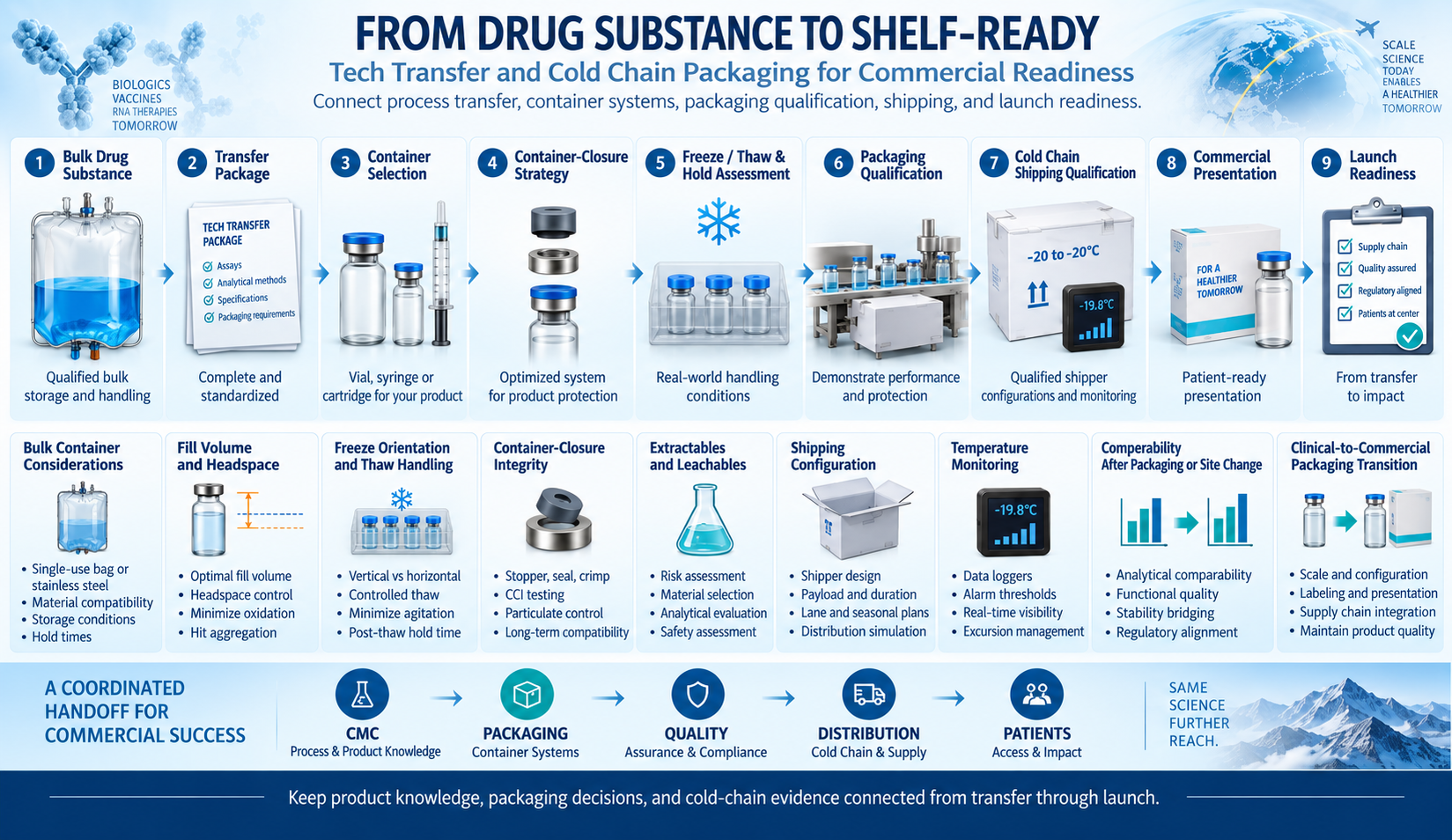
Technology Transfer Sets More Than the Manufacturing Process
WHO’s current technology-transfer guideline, published in Technical Report Series 1044, treats transfer as a structured project that includes due diligence, quality risk management, documentation, premises and equipment, qualification and validation, execution, and formal closeout. That structure is useful because it forces the sending and receiving units to define what knowledge must move with the process.
Packaging and cold-chain requirements belong in that knowledge package even when they are not the first items listed on a process-transfer checklist. The receiving site needs to know what container is used for bulk drug substance, how it is frozen or refrigerated, what thaw and hold assumptions apply, which materials contact the product, how filled units are packaged, and which shipping conditions have been qualified.
If those decisions remain outside the transfer plan, the receiving site can reproduce the process and still be unable to reproduce the product’s storage and distribution conditions. That is not a paperwork gap. It is a product-control gap.
Why the Bulk Drug Substance Container Matters Early
Bulk drug substance can spend significant time in a bag, bottle, or other intermediate container before fill-finish. The container affects how quickly the material freezes and thaws, how temperature gradients develop, how much surface contact occurs, and how easily the material can be mixed after thaw.
Those factors can matter for proteins and conjugated biologics that are sensitive to aggregation, interface stress, or prolonged holds.
A transfer should therefore define more than the nominal container volume. It should capture material of construction, fill volume range, headspace, freeze orientation where relevant, thaw method, mixing expectations, allowable hold time, and any container-specific handling limits.
If the receiving site uses a different bag size or freezing configuration, that change should be assessed for its effect on the process and product before it becomes routine.
The same logic applies when clinical-scale containers are replaced for commercial operation. A larger bulk container may improve efficiency but change thermal behavior enough that the old freeze-thaw study no longer represents the commercial process.
Container Closure Belongs Inside Transfer Planning
For drug product, the container-closure system is part of the product presentation and a component of the stability and sterility strategy. Vial, stopper, seal, syringe, cartridge, or other components can affect extractables and leachable, adsorption, container-closure integrity, delivery performance, and shipping behavior.
FDA’s longstanding container-closure guidance remains in effect, and FDA issued a new draft guidance in August 2026 titled Container Closure Systems for Human Drugs and Biological Products. The August 2026 document is draft guidance, not for implementation, so it should be used as a current signal of FDA thinking rather than presented as a binding final standard.
The draft asks sponsors to describe component materials, manufacturers, dimensions, and relevant preparation steps such as washing, coating, sterilization, or depyrogenation. It also gives more attention to how the system behaves under the storage and shipping conditions the product will actually experience. That makes packaging information useful during transfer, not only when Module 3 is being assembled.
What FDA’s August 2026 Draft Adds to the Conversation
One of the most useful points in the draft concerns container-closure integrity testing, or CCIT, under extreme conditions. FDA notes that seal integrity can be transiently compromised during very low-temperature storage or shipping. An elastomeric closure can lose elasticity at an extreme temperature and reseal after warming.
If the integrity test is performed only after the container returns to room temperature, the temporary failure may be missed.
The draft therefore recommends considering worst-case conditions when selecting CCIT methods and, where appropriate, testing at the extreme temperature itself. FDA also encourages deterministic integrity methods. Probabilistic approaches may still be acceptable, but the draft notes that they can be more difficult to design, validate, and implement.
This is directly relevant to tech transfer because the integrity strategy may depend on the exact container, stopper, capping process, storage temperature, and shipping profile used at the receiving site. A change in any one of those elements can change what the integrity study needs to demonstrate.
Cold Chain Qualification Has to Match the Container System
A cold-chain package does not protect the product independently of the primary container. The two systems experience the same thermal and physical stresses during distribution. FDA’s August 2026 draft discusses shipping studies that evaluate the container-closure system after intended commercial shipping and recommends qualification of cold-chain shipping containers with temperature recording at worst-case temperature and time conditions.
Where applicable, freeze-thaw or thermal-cycling studies should represent the normal and worst-case shipping, storage, and handling conditions for the drug in its intended commercial container. ASTM and ISTA standards can be useful resources for building those studies, but they should not be described as universal legal requirements.
The study design still needs to reflect the product, the packout, the lane, and the intended distribution model.
This is where packaging engineering and CMC strategy need the same source data. Stability defines what temperatures and durations the product can tolerate. Packaging engineering designs the configuration intended to keep the product within those limits. Shipping qualification then demonstrates that the design works under representative stress.
Tie the Packaging Story Back to Comparability
A tech transfer can involve changes in site, equipment, scale, container, shipping configuration, or storage process. ICH Q5E provides the central framework for assessing whether manufacturing changes to biotechnology or biological products affect quality in a way that could affect safety or efficacy. The guideline applies to changes made during development as well as after approval.
For a biologic or ADC, the comparability package should be shaped by what actually changed. If a bulk container changes, freeze-thaw behavior and hold-time data may be relevant. If the final container or stopper changes, product-contact compatibility, container-closure integrity, stability, and delivery performance may need review.
If shipping conditions change, the study should show that the new configuration does not create a new quality risk.
The mistake is to treat packaging as outside CMC until the process transfer is already finished. By then the program may have to reopen studies that could have been designed once around the intended commercial presentation.
The Transfer Package Should Carry Packaging Decisions as Controlled Data
Technology-transfer documents usually focus on process descriptions, master records, analytical methods, equipment requirements, and validation status. Packaging decisions can sit in separate engineering files or vendor specifications even though they affect the same receiving-site execution. Bringing those records into the transfer governance model makes ownership easier to follow.
The receiving organization should know which packaging components are approved for use, which suppliers and component versions were evaluated, which shipping configuration was qualified, what temperature-monitoring setup was used, and which studies support the current limits.
Changes should enter the same assessment process used for manufacturing and analytical changes when they can affect product quality or the approved control strategy.
That approach also helps during launch preparation. Packaging engineering can work from controlled product and process information, while CMC and quality teams can see when a packaging change creates a stability, integrity, comparability, or filing consequence. The handoff becomes easier to manage because the product, package, and distribution assumptions remain connected.
How to Carry the Design from Clinical Supply to Launch
Clinical packaging often begins with a configuration chosen for speed and limited batch size. Commercial packaging has to support a much larger operating model: higher volumes, more distribution lanes, artwork control, serialization or regional labeling where applicable, longer shelf life, launch inventory, and ongoing change management.
The transition does not require the clinical package to look exactly like the final commercial presentation. It does require the team to know which choices are temporary and which data will need to be regenerated if they change. Container materials, storage conditions, primary packaging, secondary packout, shipping configuration, and administration components should all have an owner and a planned decision point.
Stability planning should also reflect the current regulatory status of the guidance being used. The consolidated ICH Q1 stability guideline remains draft as of September 2026 and is not for implementation in the United States. The existing final stability guidances, including Q1A and Q5C where applicable, remain the operative references while the consolidated revision moves through the ICH process.
A DES x Adept Handoff Model
A practical transfer model should connect CMC and packaging work before the receiving site is expected to execute. That means aligning a few decisions early:
- Product and process knowledge needed by the receiving site, including bulk storage, freeze-thaw, and hold-time assumptions
- Primary container-closure selection and the studies needed for compatibility, integrity, and stability
- Cold-chain packout, temperature-monitoring, and shipping qualification based on the product’s supported storage range
- Change and comparability planning when the receiving site, container, equipment, or distribution model differs from the clinical process
- Commercial-readiness activities such as artwork, component sourcing, packaging-line fit, launch inventory, and lifecycle change control
Partner with DES Pharma Consulting and Adept Packaging
DES Pharma Consulting and Adept Packaging support pharmaceutical and biotech teams that need CMC, quality, technology transfer, and packaging execution to move on the same timeline. DES brings process, analytical, quality, supply-chain, and regulatory CMC support, while Adept brings packaging strategy, engineering, qualification, and launch execution. For programs moving from drug substance transfer into a shelf-ready commercial presentation, the coordinated model helps keep product knowledge, packaging decisions, and cold-chain evidence connected from development through launch.

Senior Consultant, Process Development & CMC