

For biologics such as monoclonal antibodies, recombinant proteins, vaccines, and advanced cell and gene therapies, thermal integrity is part of product quality. It is a product quality requirement. These molecules can lose biological activity, shift conformation, form aggregates, or degrade in other ways when storage and transport conditions move outside the validated temperature range. That makes cold chain management an extension of the control strategy that begins in development and must remain intact through commercial distribution.
That distinction matters in practice. A temperature excursion is not judged simply by whether a warehouse or vehicle moved out of range for a short time. Cross-functional teams must ask what the product actually experienced, how long the exposure lasted, whether the event remained within the available stability margin, and whether the supporting records are reliable enough to defend a disposition decision. Two products can experience the same temperature number and reach very different outcomes, depending on the duration, the formulation, the packaging, and the history of prior stress.
A practical cold chain strategy therefore has two equally important jobs. The first is prevention: reducing avoidable excursion risk through qualification, monitoring, packaging design, lane assessment, and clear operating controls. The second is response: supporting a disciplined investigation when a deviation still occurs, using data, stability knowledge, and quality system infrastructure to reach a defensible decision.
What Cold Chain Control Should Actually Achieve
Effective cold chain control for biologics does more than move product under refrigeration. It preserves the validated storage condition, protects the product during known distribution stresses, and gives the sponsor traceable evidence that quality remained under control from manufacturing through delivery.
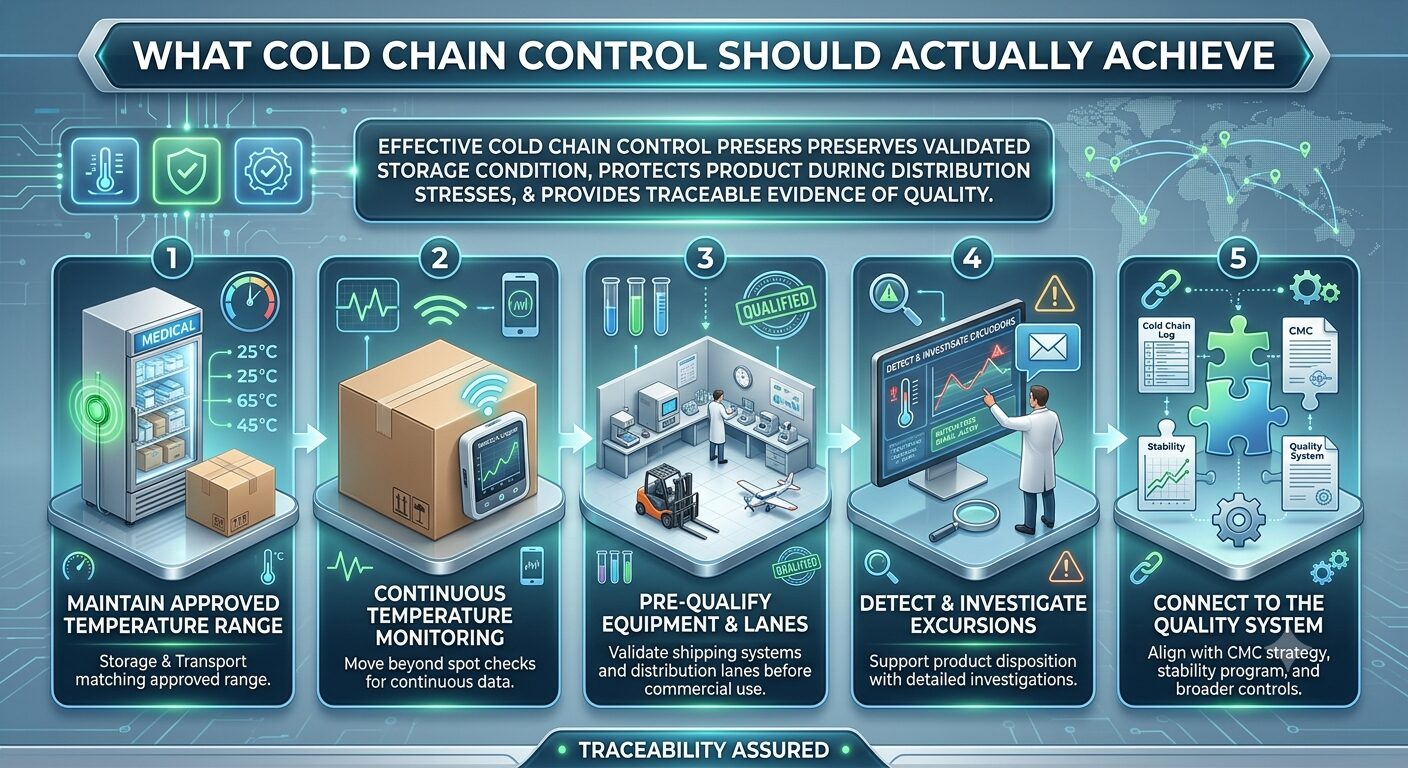
In operational terms, a biopharma cold chain program should be able to do five things consistently:
- Maintain storage and transport conditions that match the approved or development-stage temperature range
- Use continuous temperature monitoring rather than periodic spot checks for temperature-sensitive product
- Qualify equipment, shipping systems, and distribution lanes before routine commercial use begins
- Detect, investigate, and document temperature excursions in a manner that supports product disposition
- Connect cold chain controls back to the CMC strategy, stability program, and broader quality system
If any one of those elements is weak, the entire system becomes harder to defend. A qualified shipper cannot compensate for a warehouse that was never mapped properly. A datalogger cannot rescue a lane that was never assessed under realistic conditions. A clear excursion report has limited value when the product’s stability budget for temperature deviations was never established in the first place.
The Regulatory and Standards Framework That Governs Biologics Cold Chain
Cold chain management for biologics sits inside a defined compliance framework. USP <1079> describes a risk-based approach to storing and transporting finished drug products, with emphasis on environmental mapping, continuous monitoring, and distribution controls. EU GDP guidelines set strict expectations on traceability, premises, equipment quality, documentation, and transport oversight for medicinal products. WHO guidance for cold chain products reinforces temperature distribution studies, good storage practices, and handling controls across the full supply chain.
For sponsors operating across markets, that means biologics storage and distribution must be documented in a way that shows where product was held, what temperature it experienced, whether monitoring devices were appropriate and calibrated, how alarms were handled, and how records were retained. When electronic monitoring, automated alerts, or digital data capture are involved, 21 CFR Part 11 and related data integrity expectations also apply.
That combination of GDP compliance, validated monitoring, and documented quality review is what turns cold chain control into something regulators and auditors can trust. It also explains why cold chain oversight cannot simply be delegated to a carrier or distribution vendor as a routine logistics matter.
How Qualification Reduces Excursion Risk Before the First Shipment
The most effective cold chain risk reduction work happens before commercial distribution begins. Equipment qualification and lane qualification form the foundation. Refrigerated rooms, freezers, environmental chambers, vehicles, reefers, and staging areas all require an IQ/OQ/PQ framework that demonstrates the system is installed correctly, operates as intended, and performs acceptably under expected conditions. Mapping studies should identify hot and cold spots, document recovery behavior after door openings, and account for seasonal temperature variability where relevant.
The same principle applies to transport lanes. A biologic may travel safely through one route and encounter unacceptable thermal stress on another because of dwell time, customs delays, airport exposure, seasonal extremes, or handling transfers. Lane qualification should reflect real shipping conditions rather than paper assumptions about nominal transit time. For products with narrow thermal tolerances, the lane qualification study often carries as much risk-management weight as the insulated shipping system itself.
This is where a CMC cold chain strategy becomes operational rather than conceptual. Development, manufacturing, quality, and supply chain teams need a shared understanding of the approved storage range, the short-term excursion tolerance with stability data to support it, the packaging design basis, and the controls expected at each node of the distribution network. When logistics design is disconnected from the product stability story, the first serious excursion can quickly become a disposition crisis.
Why Packaging Qualification and Monitoring Design Are Both Critical
Thermal packaging qualification is not a matter of selecting a box from a catalog. Passive systems, active systems, refrigerants, phase change materials, payload configuration, packout instructions, and seasonal profiles all affect whether a shipper protects product under real transport stress. ISTA 7E is widely used to evaluate thermal transport packaging performance against defined external temperature profiles, and many sponsors combine that work with lane-specific assessment to understand how the packout performs under realistic conditions.
Monitoring design is equally important and sometimes underweighted. The sponsor should know what the sensor is measuring, where it is placed within the shipping unit, how frequently it records, how alarms are triggered, and how data are reviewed after a shipment completes. A monitoring program that produces incomplete data files, allows overwritten records, or relies on uncontrolled spreadsheets creates its own category of risk. If temperature data are used to support a quality decision, the records need appropriate security, traceability, and audit trail control consistent with the intended use of the system.
Prevention ultimately depends on three linked controls working together: a qualified storage environment, a qualified packaging system, and trustworthy monitoring data. That combination shifts the organization away from reactive excursion management and toward a validated cold chain design that has already anticipated normal distribution stress.
When a Temperature Excursion Occurs: A Structured Response
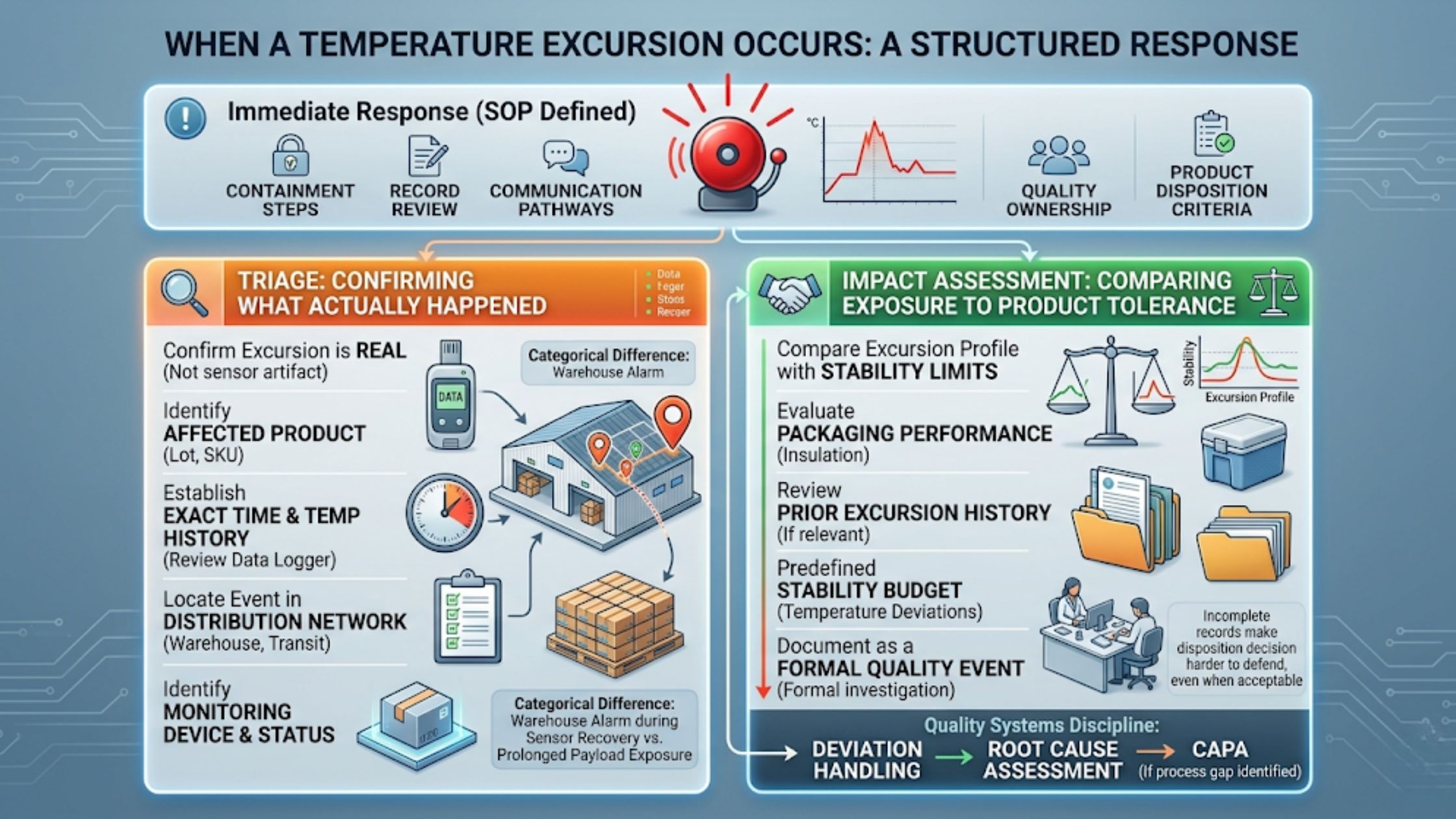
Even a well-controlled distribution network will eventually encounter a delayed handoff, an alarm event, a freezer upset, or a shipment that arrives outside the acceptable temperature range. At that point, the organization should not improvise. A temperature excursion SOP for biologics should define immediate containment steps, record review requirements, communication pathways, quality ownership, and product disposition criteria.
Triage: Confirming What Actually Happened
The first priority is triage. Teams need to confirm whether the excursion is real, identify which product was affected, establish the exact time and temperature history, locate the event in the distribution network, identify the monitoring device involved, and determine whether any additional handling details affected the risk. A brief warehouse alarm during sensor recovery is categorically different from a prolonged payload exposure. A single data point without context is not a basis for a disposition decision.
Impact Assessment: Comparing Exposure to Product Tolerance
The next step is impact assessment. This means comparing the excursion profile with the product’s known stability limits, packaging performance, prior excursion history where relevant, and any predefined stability budget for temperature deviations. The investigation should be documented as a formal quality event. Incomplete records make the decision harder to defend, even when the product may in fact remain acceptable. Quality systems discipline matters here: the event should move through deviation handling, root cause assessment, and CAPA or preventive actions when the issue points to a broader process gap.
How Stability Data and MKT Support Defensible Disposition
A temperature excursion does not automatically mean batch rejection. Biologics are sensitive, but disposition decisions should be driven by science, not precaution alone. The available evidence typically comes from real-time stability data, accelerated studies, stress work, prior excursion assessments where available, and the product-specific rationale that defines the acceptable stability budget.
Mean kinetic temperature (MKT) can be a useful analytical tool in that process. It converts a variable temperature exposure profile into a single calculated value that reflects cumulative thermal stress, which can help teams understand whether a fluctuating excursion imposed more burden than a simple average temperature would indicate. However, MKT is not a substitute for product-specific knowledge, and it should not function as an automatic release criterion for excursion events. Interpretation must remain grounded in the product’s actual stability behavior and in the specific duration and pattern of exposure.
That is precisely why the stability program matters. ICH Q1A(R2) provides the general framework for real-time, accelerated, and stress testing used to establish storage conditions and justify shelf-life claims. For biologics, that data should also inform a practical excursion assessment model. When a sponsor understands how short exposures at defined temperatures affect potency, aggregation, purity, or other critical quality attributes, the quality team is positioned to make a defensible disposition decision rather than a precautionary one.
Sound disposition depends on three things: reliable excursion data, a product-specific stability budget, and a quality investigation that documents the reasoning clearly. Without that combination, high-stakes decisions rest on incomplete information.
Cold Chain Readiness Across the Product Lifecycle
The right cold chain control strategy changes with the stage of development and commercialization, but the core expectation is consistent at every phase: the sponsor should know the product’s thermal sensitivity, understand the distribution risks, and maintain records that support a clear quality decision when conditions move out of range.
| Lifecycle Stage | Cold Chain Readiness Requirements |
| Development Stage | Define the intended storage range, build the early stability package, identify likely excursion sensitivities, and align packaging and lane concepts with product thermal behavior. |
| Clinical Distribution | Qualify storage environments, monitoring systems, and shipping configurations appropriate to the study footprint. Tighten excursion handling and documentation before distribution complexity grows. |
| Registration and Launch Preparation | Connect shelf-life claims, labeled storage conditions, packaging qualification, lane qualification, monitoring design, and deviation handling into one defensible control strategy. |
| Commercial Lifecycle | Trend excursions, reassess lanes seasonally, review carrier performance, maintain qualified states, and update monitoring controls and CAPA actions when the distribution network changes. |
Why Cold Chain Management Has to Operate Inside the Quality System
Cold chain control breaks down when organizations treat it as a shipping topic that sits outside the quality system. The real failure typically starts earlier: in weak mapping studies, incomplete qualification, poor monitoring design, unclear responsibilities, or excursion SOPs that were never tested under real operational conditions.
Biologics make those weaknesses expensive. A product that degrades after thermal stress can create clinical risk, supply loss, regulatory scrutiny, and avoidable financial damage simultaneously. Cold chain risk management must therefore be visible across ordinary technical operations: in warehouse control, packaging design, carrier oversight, deviation review, stability planning, and change management.
The organizations that handle excursions well are consistently the ones that built the science and the records before the event occurred. They know the product’s thermal limits, they understand the lane, and they can explain their disposition logic with evidence rather than assumptions. That preparation does not happen during an excursion investigation. It happens during qualification, stability work, and routine quality oversight.
Partner with DES Pharma Consulting
DES Pharma consulting supports sponsors and technical operations teams with cold chain strategy across development and commercial distribution. Services include GDP-aligned control design, storage and transport qualification, packaging and lane risk assessment, excursion response planning, and stability-based disposition support. If your team is building or strengthening a biologics cold chain program, DES can structure the work so it is technically sound, inspection-ready, and aligned with your product lifecycle stage.

Matt specializes in Process Development (PD) and Chemistry, Manufacturing, and Controls (CMC) strategy, helping life sciences companies navigate early-stage development, lab innovation, and technical regulatory hurdles.
Reach out to Matt on LinkedIn.