

Two Ways to Lose a Biologic
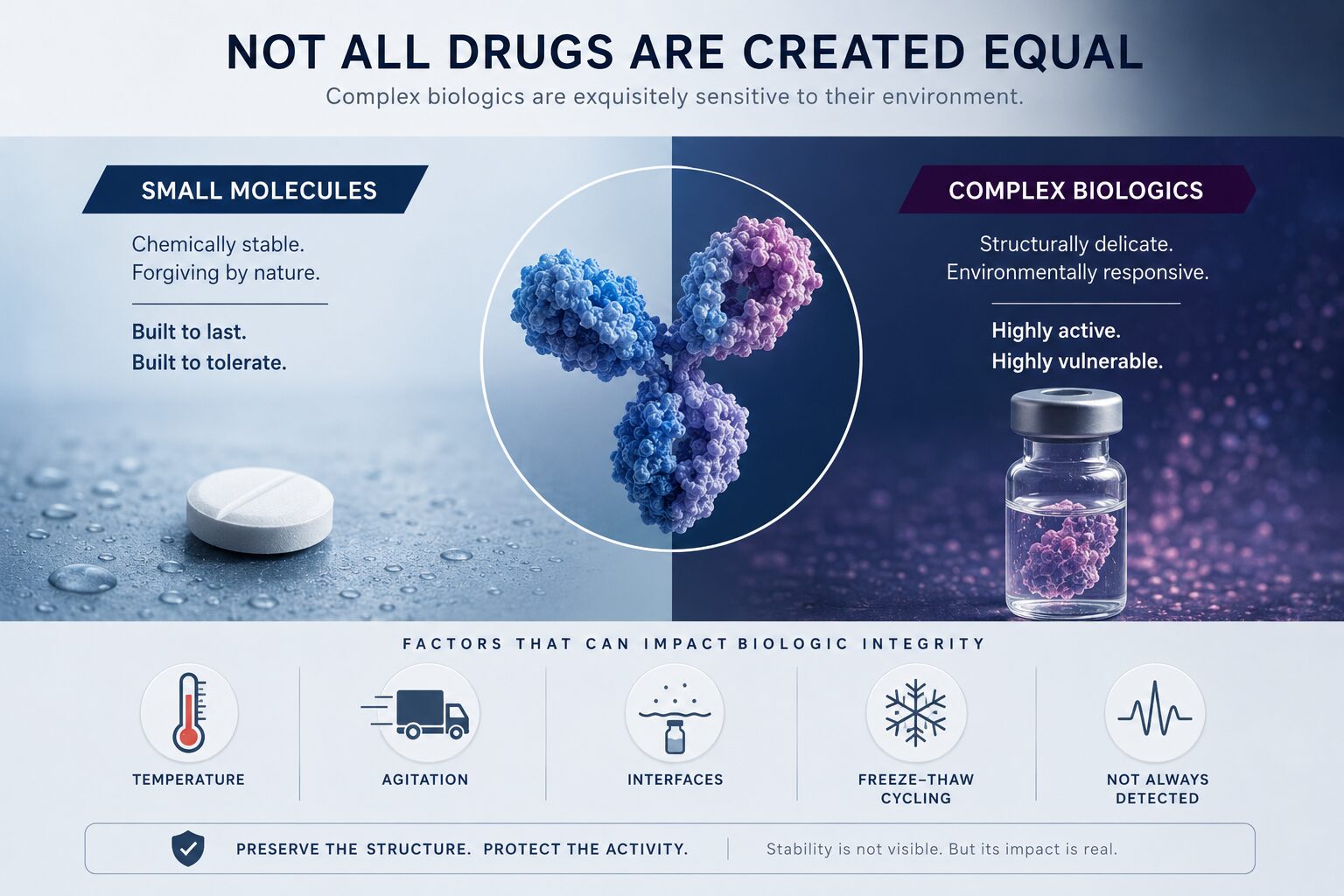
Small molecules forgive a great deal. A tablet that spends six hours on a warm loading dock is usually still a tablet. A monoclonal antibody, a viral vector, or a cell therapy is a different proposition entirely. Its activity depends on a folded three dimensional structure held together by weak forces, and that structure responds to temperature, to agitation, to interfaces, and to freeze-thaw cycling in ways that are not always visible in a routine assay.
This creates two distinct risk domains. The first is intrinsic: does the molecule, in this formulation, produced by this process, hold its critical quality attributes across the claimed shelf life? The second is extrinsic: does the shipping system keep the product inside its qualified temperature range across the worst lane, the worst season, and the worst delay the network can produce?
Teams frequently over-invest in one domain and under-invest in the other. A beautifully characterized formulation shipped in an unqualified box is a recall waiting to happen. An engineering-grade thermal shipper protecting a product whose degradation pathways are poorly understood simply protects the wrong thing. The programs that hold up are the ones where formulation science and distribution engineering are specified against each other.
DES Pharma: Keeping the Molecule Potent
Process development that produces a stable article
Stability begins upstream, well before anyone selects a container or a shipper. Cell line performance, harvest conditions, purification train design, buffer exchange strategy, and the final concentration step all determine the aggregate burden, charge variant distribution, and residual impurity profile that the product carries into storage. DES Pharma’s program and process development work targets those levers directly, defining a design space in which the process delivers a consistently stable article rather than one that happens to pass on a good day.
Formulation development runs alongside it. Buffer species and pH set the deamidation and aggregation landscape. Surfactant level governs behavior at air and silicone interfaces during agitation, which is exactly the stress a product encounters in transit. Cryoprotectant selection determines what survives freezing, and whether the product tolerates the freeze-thaw cycles that real distribution networks impose whether or not anyone planned for them.
Product characterization that goes past release testing
Release specifications describe a narrow window. Characterization describes the molecule. Higher order structure by circular dichroism and differential scanning calorimetry, aggregation and fragmentation profiling across orthogonal separation techniques, glycan mapping, charge heterogeneity, subvisible particle distribution, and forced degradation studies together build a picture of which changes matter and which are noise. Academic groups have documented extensively how interfacial and freeze-thaw stresses generate particles in protein formulations, and that literature is only useful to a program once the program has characterized its own molecule well enough to recognize the same signatures.
Analytical method validation as the ability to see failure
A cold chain excursion investigation is only as credible as the assay used to assess impact. If the potency method has a variability band wider than the effect being investigated, the investigation cannot conclude anything. Quality control and analytics work therefore focuses on methods that are demonstrably stability indicating, validated for accuracy, precision, specificity, and range against the relevant ICH expectations, and sensitive enough to resolve the degradation products that thermal stress actually produces. The FDA Center for Biologics Evaluation and Research publishes the regulatory framing for these expectations, and reviewers read excursion assessments closely.
Adept Packaging: Protecting the Product Physically
Secondary and tertiary packaging engineering
The vial or syringe is only the innermost layer. Cartons, inserts, dunnage, trays, and shipping cases determine whether a container survives drop, vibration, compression, and stacking loads across a multimodal route. They also determine thermal mass distribution inside the shipper, which changes how the payload behaves during an excursion. Adept Packaging’s pharmaceutical packaging engineering treats these layers as one integrated system tested against recognized distribution simulation standards, rather than as separate purchasing decisions made by different departments.
Passive and active thermal shippers
Passive systems use insulation and phase change material with no power source. They are simpler, cheaper, and predictable, and they are the right answer for defined durations on well-characterized lanes. Active systems use powered refrigeration or compressed gas control, hold tighter tolerances over longer durations, and can handle deep frozen or cryogenic requirements, at higher cost and with more operational overhead.
The engineering question is never which type is better. It is which qualified duration the network requires, measured against the ambient profiles the lane actually produces. Qualification means thermal mapping with worst case payload configurations, summer and winter ambient profiles, and deliberate abuse testing, not a single successful shipment used as evidence.
Data logger integration
A shipper without monitoring is an assumption. Single use and reusable loggers, real time connected devices, and lane analytics turn distribution into a measured process. Placement matters as much as device selection, because a logger reading ambient air inside a shipper tells a different story than one placed against the payload. Sampling interval determines whether a short spike is captured or averaged away. Alarm thresholds should be derived from the product’s stability data rather than copied from a template, which is the point at which the packaging work depends directly on the characterization work. Research on temperature-controlled distribution at institutions such as Michigan State University has long emphasized that measured distribution environments, not assumed ones, are what make protective packaging defensible.
The Market Is Moving Toward Tighter Control
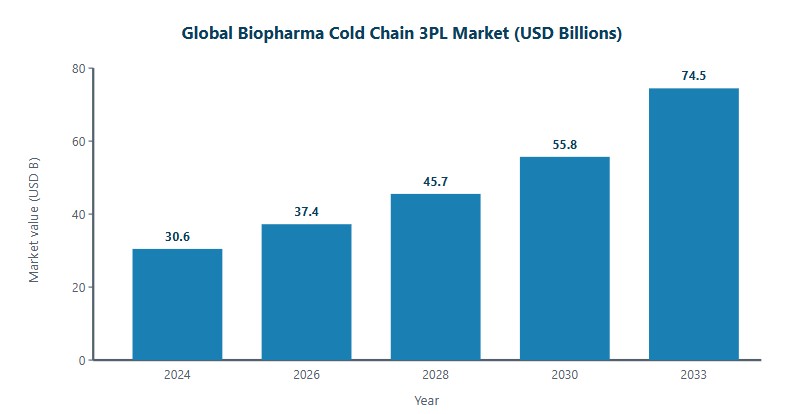
Anchor values for 2024 and 2033 reported by Grand View Research; intermediate years interpolated at the reported 10.54% compound annual growth rate. (Source)
Growth of this size is not just more volume moving through the same systems. It reflects a pipeline shifting toward cell and gene therapies, personalized products with single patient batches, and deep frozen requirements that leave no margin for an unqualified lane. It also means supply chain and procurement decisions now carry direct product quality consequences rather than purely commercial ones.
Building the Two Disciplines Into One Program
Practically, alignment looks like this. Stability data defines the allowable excursion budget, expressed as cumulative time out of range rather than a simple pass or fail. Shipper qualification is designed against that budget and against measured lane ambient profiles. Logger alarm limits are set from the same stability dataset. Excursion investigations run against validated methods capable of detecting the effect in question. And when a lane changes or a new market opens, both sides revisit the assessment together rather than one side assuming the other already did.
Frequently Asked Questions
How do stability data and shipper qualification connect?
Stability studies, including deliberate temperature cycling and excursion studies, define how much time out of range a product can absorb without losing quality. That budget becomes the design requirement for shipper duration and the basis for logger alarm thresholds. Without it, qualification targets are arbitrary.
When is an active shipper justified over a passive one?
Active systems earn their cost when transit durations exceed reliable passive hold times, when tolerances are narrow, when deep frozen or cryogenic conditions are required, or when payload value makes the risk of loss dominate the shipping cost. For shorter well-characterized lanes, a properly qualified passive system is often the more reliable choice because it has fewer failure modes.
What makes an analytical method stability indicating for a biologic?
It must resolve and quantify the degradation products that the molecule actually forms under relevant stress, without interference from excipients or from other product variants. Demonstrating this requires forced degradation studies across thermal, oxidative, photolytic, mechanical, and freeze-thaw stress, followed by validation for specificity, accuracy, precision, and range.
Where should data loggers be placed inside a shipment?
Placement should be driven by thermal mapping rather than convenience. Positions that represent the payload, including the locations shown to be most and least thermally protected, give a defensible record. A single logger sitting in the headspace of a shipper measures the air, not the product.
Does a temperature excursion automatically mean product rejection?
No, provided the program has the data to assess it. If cumulative time out of range falls inside a pre-established budget supported by stability studies, and validated methods confirm no meaningful quality impact, the material can often be released with documented justification. Programs without that groundwork are forced into conservative rejection.
One Product, Two Kinds of Protection
A biologic reaching a patient at full potency is the outcome of two engineered systems working to the same specification: a process and formulation designed to keep the molecule intact, and a distribution package designed to keep the environment inside the range the molecule was designed for. DES Pharma Consulting and Adept Packaging build those systems against each other, so the stability data that defines the product also defines the box it travels in.

Matt specializes in Process Development (PD) and Chemistry, Manufacturing, and Controls (CMC) strategy, helping life sciences companies navigate early-stage development, lab innovation, and technical regulatory hurdles.
Reach out to Matt on LinkedIn.