
Receiving an FDA Form 483 can be one of the most consequential moments in a pharmaceutical company’s regulatory lifecycle. The document identifies objectionable conditions observed by FDA investigators during an inspection and can become an important factor in the agency’s subsequent compliance decision.
However, a Form 483 is not itself a final FDA determination that a company has violated the law. FDA explains that the agency considers the Form 483 together with the Establishment Inspection Report (EIR), evidence collected during the inspection, and the company’s response before determining whether further regulatory action is appropriate.
That distinction is important—but it should not create complacency. A well-structured, evidence-based response can demonstrate effective quality management and meaningful corrective action. A vague, defensive, or poorly supported response can create additional regulatory concerns.
Here is a step-by-step approach to responding effectively.
1. Understand Exactly What the Form 483 Means
A Form 483 contains the investigator’s inspectional observations. FDA states that observations are listed in order of risk significance and generally identify specific conditions that, in the investigator’s judgment, may indicate violations of applicable requirements.
The first step is therefore to resist the temptation to immediately draft a response.
Instead, establish a cross-functional response team involving Quality Assurance, Quality Control, Manufacturing, Regulatory Affairs, Engineering, Validation, Supply Chain, and senior management as appropriate.
Each observation should be evaluated independently and then considered as part of the company’s broader pharmaceutical quality system.
2. Build an Observation-by-Observation Response Matrix
Create a controlled response matrix immediately after the inspection.
For each Form 483 observation, document:
- The exact FDA observation
- The applicable regulation or guidance
- The company’s initial assessment
- Immediate containment actions
- Root cause
- Product and patient impact assessment
- Corrective actions
- Preventive actions
- Responsible owner
- Completion date
- Supporting evidence
This approach prevents a common mistake: responding to what the company thinks FDA meant rather than addressing what the investigator actually documented.
FDA also emphasizes that a Form 483 is not necessarily an exhaustive list of every potential deficiency. Companies remain responsible for identifying and correcting related problems that may not have appeared on the form.
3. Meet the 15-Business-Day Deadline
Timing is critical.
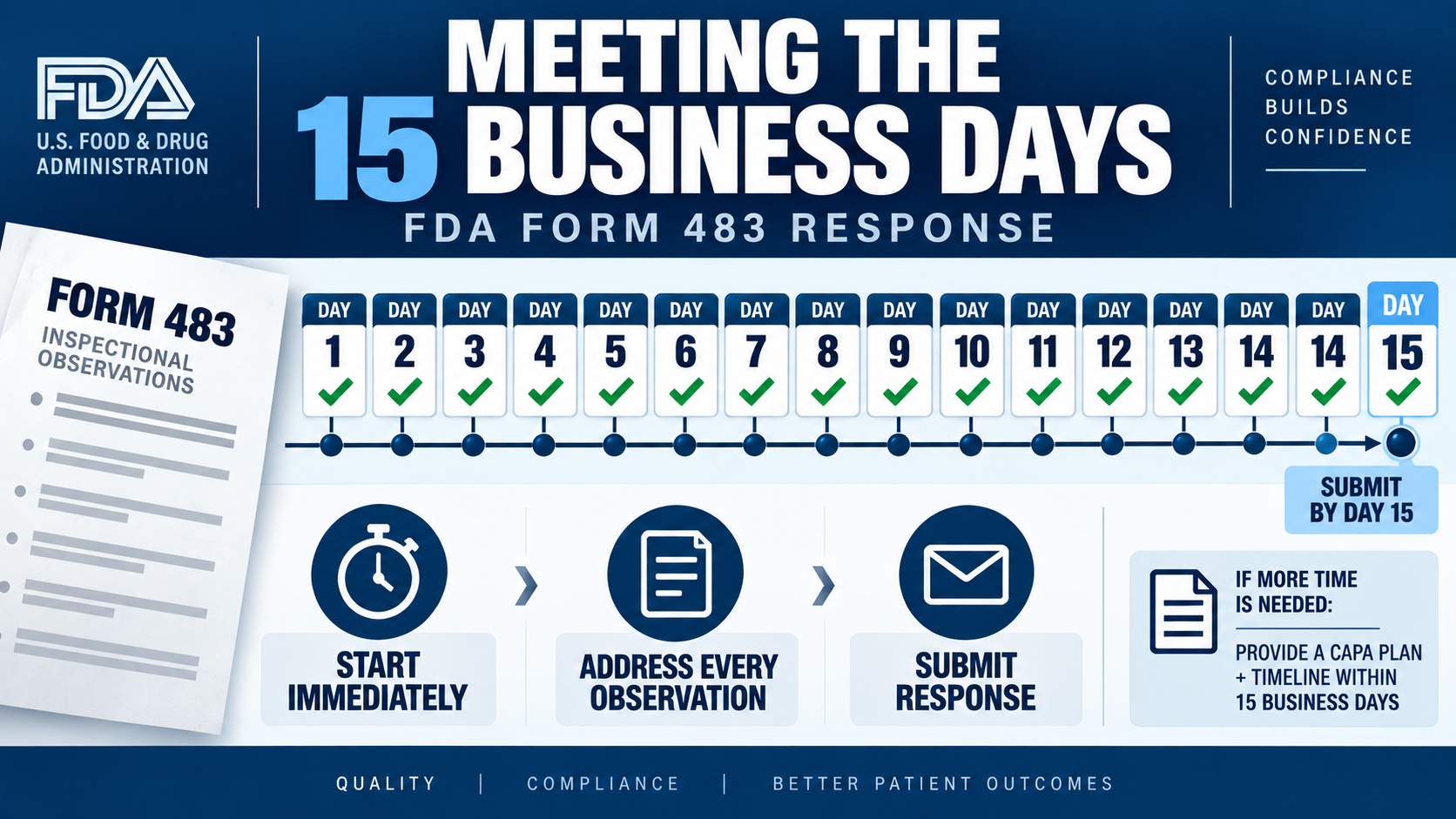
FDA’s March 2026 draft guidance specifically recommends that establishments submit a single response addressing all Form 483 observations within 15 business days after the Form 483 is issued. If a complex observation cannot be fully addressed within that period, FDA recommends providing a substantive CAPA plan and proposed timeframe within the 15-business-day window.
Importantly, FDA states that it will not ordinarily delay regulatory action simply to review a response submitted more than 15 business days after the Form 483 was issued.
The practical implication is straightforward: begin the response process before the inspection is formally closed if possible.
4. Perform a Credible Root Cause Analysis
One of the biggest weaknesses in Form 483 responses is confusing the symptom with the root cause.
For example, “employees were retrained” is rarely an adequate root-cause response to a systemic GMP deficiency.
If an operator failed to follow a procedure, ask why:
- Was the procedure unclear?
- Was training ineffective?
- Was the process difficult to execute?
- Was supervision inadequate?
- Was the procedure inconsistent with actual operations?
- Did management oversight fail?
- Did the quality system allow the problem to persist?
FDA enforcement activity continues to demonstrate the importance of effective investigations and CAPA. In a 2025 warning letter, for example, FDA criticized inadequate investigations and corrective actions surrounding recurring manufacturing failures.
Organizations requiring broader remediation may benefit from structured FDA remediation consulting to ensure that individual observations are evaluated as potential indicators of systemic quality-system weaknesses.
5. Evaluate Data Integrity and Computerized Systems
Data integrity remains a major regulatory concern, particularly where laboratory, manufacturing, electronic records, and computerized quality systems are involved.
FDA warning letters in 2025 and 2026 continued to identify problems involving incomplete records, unreliable laboratory data, inadequate investigations, and insufficient controls over computerized systems. For example, FDA cited deficiencies involving laboratory records and access controls in a 2025 warning letter concerning data integrity.
When a Form 483 involves electronic records or computerized systems, companies should evaluate whether controls satisfy applicable requirements for attributable, legible, contemporaneous, original, accurate, complete, consistent, enduring, and available records.
This is particularly important when implementing or validating cloud-based QMS platforms. A detailed 21 CFR Part 11 guide can help organizations evaluate the regulatory expectations surrounding electronic records and computerized systems.
6. Address the Entire Quality System—not Just the Observation
A strong Form 483 response demonstrates that the company understands the systemic implications of an observation.
FDA’s own pharmaceutical quality data illustrate why. In its analysis of FY2019 inspection findings, FDA reported that 58% of observations analyzed were associated with Records and Reports, Laboratory Controls, and Equipment. The three most frequently cited individual provisions were 21 CFR 211.192, 211.22, and 211.160.
While those figures are historical rather than a snapshot of current-year observations, they illustrate a persistent regulatory theme: deficiencies often involve the underlying pharmaceutical quality system rather than a single isolated event.
A broader GxP/GMP quality assessment can help identify whether a Form 483 observation reflects a wider pattern across procedures, personnel, facilities, documentation, validation, and quality oversight.
7. Support Every Commitment With Evidence
FDA increasingly expects companies to demonstrate—not merely promise—that corrective actions are effective.
A response should therefore distinguish between:
- Completed actions: supported by objective evidence such as revised SOPs, training records, validation reports, investigation reports, monitoring results, or implementation records.
- Planned actions: accompanied by a specific owner, milestone, deliverable, and completion date.
- Long-term actions: supported by a credible implementation strategy and effectiveness checks.
Recent FDA warning letters demonstrate the consequences of inadequate documentation. In one 2025 case, FDA described a Form 483 response as inadequate because the company failed to provide sufficient supporting documentation or adequate evidence that corrective actions had been completed.
8. Assess CMC, Supply Chain, and Product Impact
Some observations cannot be addressed solely within the Quality department.
Manufacturing-process deficiencies may require a broader CMC strategy, particularly when they affect process validation, specifications, analytical methods, stability, manufacturing controls, or regulatory submissions.
Similarly, deficiencies involving suppliers, contract manufacturers, raw materials, or distribution should trigger a broader supply-chain assessment. Current pharmaceutical supply chains face increasingly complex risks, making supply chain risk mitigation an important component of an effective remediation strategy.
For companies preparing regulatory interactions around development and manufacturing, robust documentation is equally important. Appropriate CMC documentation can help establish a defensible record of manufacturing strategy and regulatory readiness.
9. Write the Final Response for an FDA Reviewer
The final response should be factual, concise, organized, and evidence-based.
A strong structure is:
- Executive summary
- Response to Observation 1
- Response to Observation 2
- Response to Observation 3
- Root-cause analysis
- Immediate corrective actions
- CAPA plan
- Product and patient-impact assessment
- Supporting documentation
- Effectiveness monitoring
Avoid emotional language, unsupported assurances, excessive legal argument, or statements that cannot be substantiated.
Where the company disagrees with an observation, the response should explain the scientific or factual basis for that disagreement while still demonstrating that the company has evaluated the underlying risk.
10. Treat the Form 483 as a Quality-System Stress Test
The most effective response does more than close individual observations. It demonstrates that management understands why the deficiency occurred and has implemented controls designed to prevent recurrence.
FDA reports that more than 90% of pharmaceutical inspections find facilities to have acceptable CGMP compliance, but inspections resulting in observations can still have significant regulatory consequences depending on the severity and persistence of the issues identified.
FDA’s FY2025 reporting also identified 130 facilities whose failure to adequately address objectionable conditions observed during inspections resulted in a recommendation to withhold approval of an application under review.
The lesson is clear: a Form 483 should never be treated as a paperwork exercise.
A successful response connects observations to root cause, risk, remediation, evidence, and sustained effectiveness. For organizations facing complex GMP deficiencies, GMP pharmaceutical consulting can provide additional expertise in developing and executing a defensible remediation strategy.
DES Pharma’s Final Takeaway on How to Respond to an FDA Form 483 in 2026
An FDA Form 483 is a critical regulatory signal—but it is also an opportunity to demonstrate the maturity of an organization’s quality system.
The strongest responses are prompt, comprehensive, scientifically justified, evidence-based, and focused on sustainable corrective action. Start immediately, address every observation systematically, investigate root causes rather than symptoms, assess broader product and patient impact, and provide FDA with objective evidence that corrective actions are both implemented and effective.
Most importantly, remember that the goal is not simply to answer the Form 483. The goal is to demonstrate that the organization has identified the underlying problem, understands its potential impact, corrected it appropriately, and has established controls that prevent the same failure from recurring.

Senior Consultant, Process Development & CMC