
A consent decree fundamentally changes the way a pharmaceutical company must approach regulatory remediation. What might once have been treated as a collection of individual GMP deficiencies becomes a structured, court-enforceable compliance program requiring sustained oversight, documented progress, and demonstrable effectiveness. Companies entering this environment should establish a disciplined remediation framework immediately, often with support from specialized FDA remediation consulting expertise.
The stakes are significant. FDA reported 314 warning letters in 2025, including more than 120 issued to drug manufacturing facilities for adulteration violations, primarily involving significant CGMP deviations. FDA also issued 970 drug manufacturing inspection classification letters during the year. These figures illustrate the continuing regulatory focus on manufacturing quality and the importance of demonstrating sustainable compliance rather than implementing short-term fixes.
1. Start With the Consent Decree Itself
The first step is to translate every obligation in the consent decree into an actionable remediation program.
A consent decree can establish requirements involving independent experts, facility audits, quality-system improvements, manufacturing restrictions, reporting obligations, management certifications, and follow-up inspections. FDA notes that injunctions, including consent decrees, can be used when a facility fails to address CGMP violations.
Because the decree is a court order, compliance should be managed with the same discipline applied to other legally binding obligations.
Create a master obligation matrix identifying each requirement, responsible executive, deliverable, deadline, evidence requirement, and verification mechanism.
2. Divide the Program Into Multi-Year Workstreams
A successful remediation program should not be managed as one enormous CAPA project.
Instead, establish defined workstreams such as:
- Quality management system
- Investigations and CAPA
- Manufacturing and process controls
- Laboratory controls
- Data integrity
- Facilities and equipment
- Validation
- Supplier and contractor oversight
- Documentation and training
- Management oversight
Each workstream should have its own charter, milestones, risk assessment, resources, metrics, and executive owner.
This structure makes it possible to demonstrate progress while maintaining visibility into dependencies between different remediation activities.
3. Build a Phased Timeline
Multi-year remediation is best organized into distinct phases.
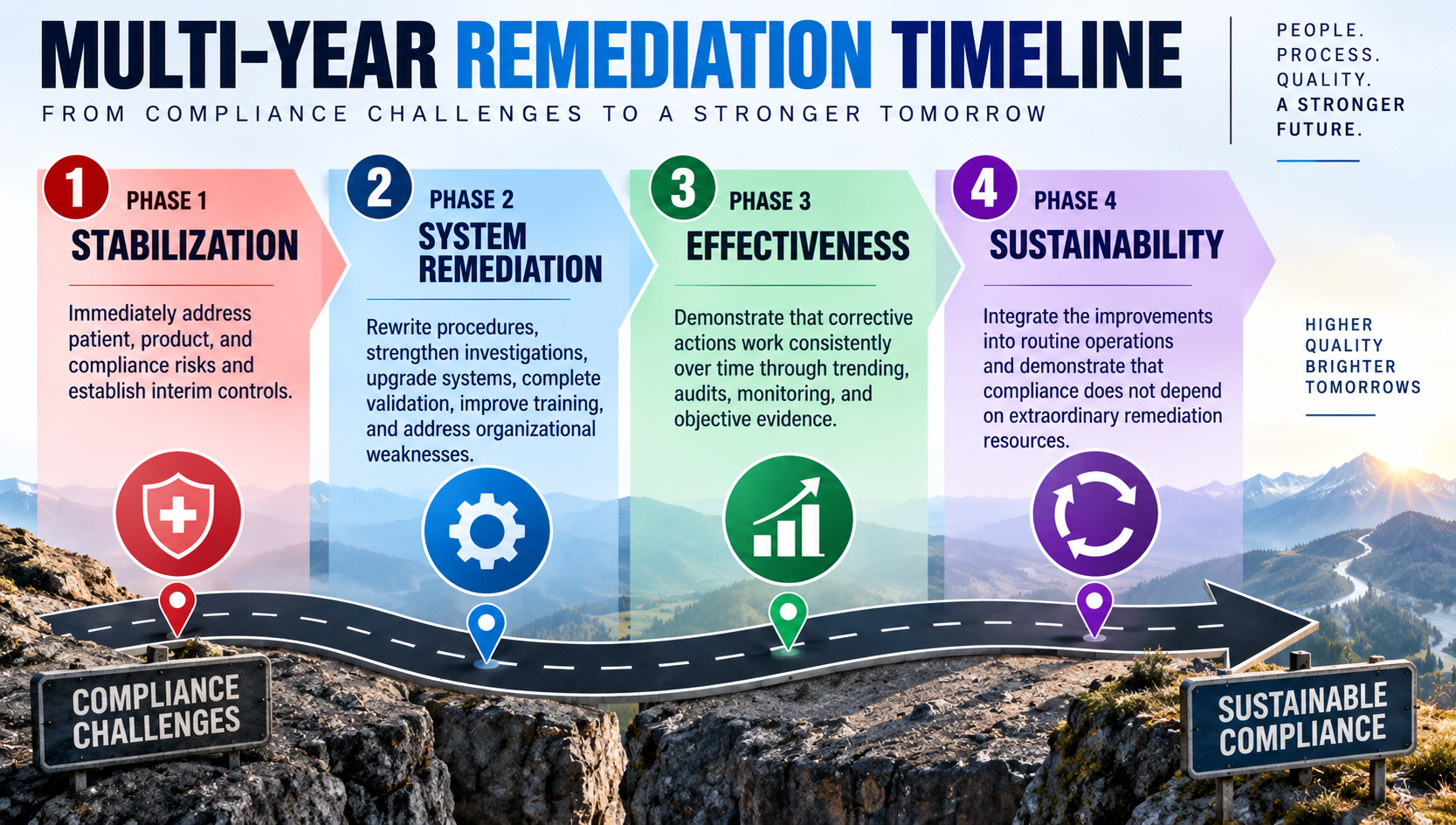
Phase 1 — Stabilization: Immediately address patient, product, and compliance risks and establish interim controls.
Phase 2 — System Remediation: Rewrite procedures, strengthen investigations, upgrade systems, complete validation, improve training, and address organizational weaknesses.
Phase 3 — Effectiveness: Demonstrate that corrective actions work consistently over time through trending, audits, monitoring, and objective evidence.
Phase 4 — Sustainability: Integrate the improvements into routine operations and demonstrate that compliance does not depend on extraordinary remediation resources.
This final phase is particularly important. FDA distinguishes basic CGMP compliance from sustainable compliance and describes quality metrics as tools for monitoring manufacturing performance and driving continuous improvement.
4. Establish Independent Oversight
Independence is often critical after a consent decree.
An organization may need an independent expert or external auditor to evaluate remediation objectively rather than relying solely on internal assessments.
The Department of Justice’s Ranbaxy consent decree, for example, required an outside expert to conduct a thorough internal review and an outside auditor to audit affected facilities in the future. Another pharmaceutical consent decree required independent inspections every six months for at least two years, followed by annual inspections for an additional three years.
The specific requirements of each decree differ, but the underlying principle is consistent: remediation must be independently credible.
5. Define Metrics Before Measuring Success
A remediation program needs objective evidence of progress.
Useful metrics may include:
- CAPA overdue rate
- Investigation cycle time
- Repeat deviations
- Laboratory error trends
- Batch rejection rates
- Complaint trends
- Environmental monitoring excursions
- Training completion
- Supplier qualification status
- Audit findings
- Data-integrity events
- Validation milestones
FDA’s Office of Quality Surveillance increasingly uses data analysis and predictive approaches to assess the state of quality at manufacturing sites and drug-product levels.
The implication for companies is important: remediation should generate reliable data that demonstrate whether quality is actually improving.
6. Strengthen the Pharmaceutical Quality System
A consent decree should ultimately result in a stronger pharmaceutical quality system, not simply a thicker collection of SOPs.
FDA’s Quality Systems guidance describes a comprehensive quality-system model for implementing modern quality systems and risk-management approaches consistent with 21 CFR Parts 210 and 211.
Companies may need specialized GMP pharma consulting to evaluate whether quality-unit responsibilities, investigations, CAPA, change control, validation, and management oversight are functioning effectively.
The goal is to make quality a controlled operating system rather than a reactive compliance function.
7. Match Resources to the Remediation Burden
Multi-year programs frequently fail because companies underestimate the personnel, technology, capital, and specialist expertise required.
Before establishing milestones, conduct a realistic assessment of pharmaceutical consulting requirements, including regulatory, technical, quality, engineering, validation, and project-management capabilities.
External expertise can be particularly valuable when internal teams are simultaneously responsible for routine manufacturing and regulatory remediation.
8. Create a Governance Structure That Survives Personnel Changes
Consent-decree programs can last years. Executive turnover, reorganizations, acquisitions, and changing business priorities should not destabilize the program.
Establish a governance structure with:
- Executive steering committee
- Program management office
- Workstream leaders
- Quality-unit oversight
- Independent expert or auditor
- Formal escalation procedures
- Monthly and quarterly reporting
- Documented decision rights
Companies evaluating external expertise can also review resources on top pharma consultants and broader pharma consulting considerations.
The Objective: Sustainable Compliance
A consent decree should be viewed as a transformation program, not simply an enforcement obligation.
FDA states that CGMP compliance represents the minimum standard for drug quality, while sustainable compliance requires consistent control over manufacturing performance and quality. FDA’s current CGMP framework encompasses requirements governing manufacturing methods, facilities, equipment, controls, and finished pharmaceuticals under 21 CFR Parts 210 and 211.
The strongest multi-year remediation programs therefore work backward from one objective: demonstrating that the company can consistently manufacture quality products without extraordinary regulatory intervention.
That requires clear governance, independent verification, measurable outcomes, sufficient resources, and above all a quality system capable of sustaining the improvements long after the formal remediation program ends.

Senior Consultant, Process Development & CMC