


TL;DR
- Definition: Pharmaceutical consulting requirements are the technical, regulatory, quality, documentation, and contractual conditions a consultant and a client must both satisfy for the work to hold up under inspection.
- Technical: Modality-specific experience, method validation literacy, process characterization, and scale-up history.
- Regulatory: Direct submission and inspection experience, current knowledge of ICH guidelines, and the ability to write agency-facing documents.
- Quality: Working command of GMP requirements, deviation and CAPA systems, change control, and supplier qualification.
- Contractual: Named personnel, confidentiality, intellectual property assignment, conflict-of-interest disclosure, insurance, and a defined deliverable set.
- Client side: Data access, one empowered internal owner, and honest disclosure of known problems.
Buyers usually ask about price before they ask about requirements, which is backwards. In a regulated industry, the requirements determine whether the work survives contact with an inspector, a partner’s due diligence team, or a health authority reviewer. This breakdown lists what to require from a pharma consulting partner, what the partner will require from you, and how to tell in a first conversation whether both sets of conditions can realistically be met. The list applies across small molecule, biologics, and advanced therapy programs, with the depth of each requirement scaling to the modality and the development phase.
What “Requirements” Means in Pharmaceutical Consulting
There is no single license that authorizes someone to practice as a pharmaceutical consultant. That absence is precisely why written requirements matter. In practice, requirements fall into six categories: technical and scientific, regulatory, quality system, documentation and data integrity, commercial and contractual, and client-side obligations. A gap in any one of them produces the same result, which is work that cannot be defended later.
Phase matters as much as category. A consultant supporting Phase 1 investigational drugs operates against a different control expectation than one supporting commercial supply, and a partner who applies commercial-stage rigor to a first-in-human batch will burn budget on controls the program does not yet need. Phase-appropriate judgment is itself a requirement.
Technical and Scientific Requirements
- Modality experience. Monoclonal antibody process knowledge does not transfer cleanly to lipid nanoparticles, viral vectors, or peptides. Ask which molecules, at what scale, in what facilities.
- Analytical method lifecycle. Development, qualification, validation, transfer, and ongoing performance monitoring, with a clear grasp of when each step is expected.
- Process characterization. Ability to link a quality target product profile to critical quality attributes and critical process parameters, and to defend those links with data.
- Scale-up and comparability. Experience designing comparability exercises that protect existing clinical data when a process changes.
- Formulation and stability. Stability protocol design, degradation pathway understanding, and container closure compatibility.
Practitioners who have trained in structured environments such as a university biomanufacturing training center or completed formal coursework in the principles of biomanufacturing tend to reason from unit operations rather than from anecdote, which shows up quickly in how they answer scale-up questions.
Regulatory Requirements
Regulatory competence is demonstrated by artifacts, not by adjectives. Require evidence of submissions the individual personally authored or defended: module 3 sections, briefing packages, responses to information requests, inspection commitments. Ask which agencies, which submission types, and what the outcome was.
A consultant supporting an IND application should be able to describe, without notes, what a reviewer typically challenges in the chemistry, manufacturing, and controls section for that modality. Current knowledge matters as well: guidance moves, and advice built on a superseded document is worse than no advice. Independent drug development research from academic centers is a reasonable check on whether a consultant’s assumptions about timelines and success rates match published evidence.
Quality System and GMP Requirements
Any consultant touching manufacturing must work from the regulations themselves. The baseline is fluency in 21 CFR Part 211, the requirements for finished pharmaceuticals, and the practical meaning of current good manufacturing practice as applied to your specific operation. Specific competencies to require:
- Deviation investigation and root cause analysis that reaches system causes, not operator blame.
- CAPA design with effectiveness checks that would satisfy a returning investigator.
- Change control assessment, including regulatory reportability determinations.
- Supplier and contract manufacturer qualification, including audit execution.
- Annual product review and continued process verification.
Organizations building or repairing these systems generally need sustained support rather than a single assessment, which is the usual scope of a dedicated GMP compliance engagement.
Where GMP Programs Break Down Most Often
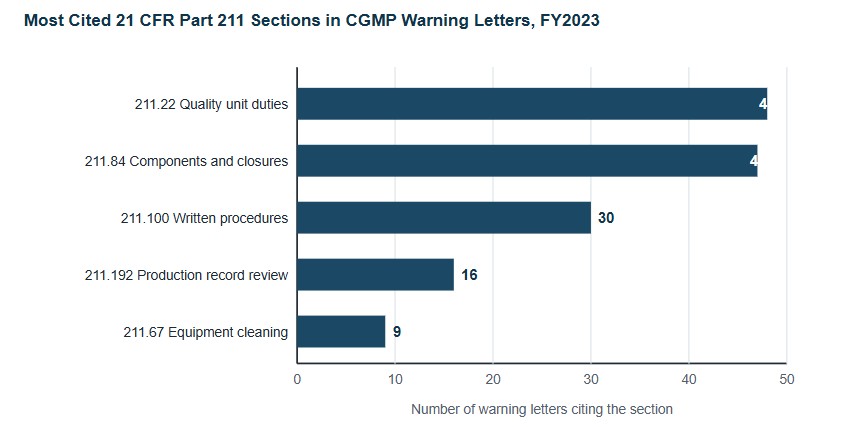
Enforcement data is the clearest available picture of which requirements matter in practice. The FDA’s Office of Compliance publishes the most frequently cited sections in CGMP warning letters, and the pattern is stable across years: quality unit authority and component control dominate, followed by written procedures and record review. When you evaluate a consultant, ask how they would strengthen each of these areas specifically.
Documentation and Data Integrity Requirements
Consultants generate records that may end up in a regulatory file, so their documentation habits become your documentation habits. Require contemporaneous notes, version-controlled deliverables, traceable data sources, and a clear distinction between opinion and evidence. Any analysis submitted to an agency must be reproducible from raw data, and the consultant should be able to produce that trail on request years later. Agree at the outset on where documents live, who owns the final record, and how draft material is retained or destroyed.
Commercial and Contractual Requirements
- Named personnel with committed hours. The contract should name individuals, not a firm.
- Intellectual property assignment. All work product, methods, and data assign to the client.
- Confidentiality and conflict disclosure. Written disclosure of competing programs in the same indication or modality.
- Insurance. Professional liability appropriate to the risk of the advice being given.
- Defined deliverables and end date. With a checkpoint that allows either party to stop work that is not producing value.
- Handover obligation. A documented transfer of reasoning, risks, and source data at close.
What the Client Is Required to Provide
Half of failed engagements fail on the client side. Before kickoff, commit to three things: complete data access including unfavorable history, one internal owner with authority to unblock, and a decision the engagement is meant to serve. Withholding a troubled deviation history or an unresolved supplier issue does not protect the program, it simply guarantees that the resulting advice is built on an incomplete picture. Early-stage companies that lack internal infrastructure for this often formalize it through a standing biotech consulting relationship rather than assembling it project by project.
A Practical Requirements Checklist
- Modality-specific experience documented with named programs.
- Personal submission and inspection history, with outcomes.
- Phase-appropriate judgment demonstrated in the first conversation.
- Working fluency in the applicable GMP regulations.
- Documentation and data integrity practices that would survive audit.
- Named individuals, committed time, and no bench substitution without approval.
- Signed confidentiality, intellectual property, and conflict terms.
- Client-side data access, an internal owner, and a defined decision.
- Written handover and knowledge transfer at close.
See How DES Pharma Supports Development Programs
Pharmaceutical Consulting Requirements: Frequently Asked Questions
Are there formal qualifications required to be a pharmaceutical consultant?
No single license governs the field. Credibility rests on demonstrable program experience: submissions authored, inspections supported, processes transferred, and problems resolved. Advanced degrees are common and useful, but they do not substitute for hands-on regulatory and manufacturing history, which is why buyers should require evidence rather than credentials alone.
What regulatory experience should a pharmaceutical consultant have?
At minimum, direct authorship or defense of submissions relevant to your modality and phase, familiarity with the applicable ICH guidelines, and experience responding to agency questions. For manufacturing work, add inspection experience and the ability to write remediation commitments that hold up on a follow-up visit.
What should a pharmaceutical consulting contract include?
Named personnel with committed hours, a scope tied to specific deliverables, intellectual property assignment to the client, confidentiality terms, conflict-of-interest disclosure, professional liability insurance, defined data access, a review checkpoint, and a written handover requirement at the end of the engagement.
How do requirements differ for early-stage versus commercial programs?
Early-stage work emphasizes phase-appropriate controls, speed to the clinic, and avoiding decisions that create later comparability problems. Commercial work emphasizes validated systems, continued process verification, supply reliability, and inspection readiness. Applying commercial rigor too early wastes money; applying early-stage informality too late creates compliance exposure.
What does the client have to provide for a consulting engagement to succeed?
Complete data access including unfavorable history, a single internal owner with authority to unblock, a clearly stated decision the work should support, and timely responses. Engagements that stall almost always stall on document access or on a client owner who lacks the authority to make the calls the work requires.
Closing Thoughts
Requirements are not bureaucracy, they are the mechanism that makes consulting work defensible later. Set them in writing before the first invoice: what the consultant must know, what they must produce, how they must document it, and what you must supply in return. Teams that do this get advice they can put in a submission; teams that skip it get opinions they have to re-verify. For a structured view of how requirements map to each development phase, DES Pharma Consulting works through them program by program rather than applying one template to every client.
Follow along for practical CMC, quality, and regulatory guidance: DES Pharma on X and DES Pharma on LinkedIn.

Matt specializes in Process Development (PD) and Chemistry, Manufacturing, and Controls (CMC) strategy, helping life sciences companies navigate early-stage development, lab innovation, and technical regulatory hurdles.
Reach out to Matt on LinkedIn.