


TL;DR
- What it is: Pharmaceutical management consulting applies outside operational, technical, and regulatory judgment to a defined company decision, most often in CMC, quality, supply chain, or portfolio planning.
- When it works: Engagements succeed when the client names the decision, grants data access, and assigns one internal owner.
- Who to hire: Buy named practitioners with hands-on filing and inspection history, not a firm logo and a rotating bench.
- How to scope: Contract around deliverables and decisions rather than hours, with a written scope, a data list, and a defined end date.
- How to measure: Track cycle time to the next milestone, inspection and audit outcomes, rework avoided, and whether the internal team can run the process without the consultant.
Pharmaceutical management consulting sits where science, regulation, and operations meet. Companies bring in outside advisors when an internal team is capable but stretched, when a decision carries regulatory consequences that nobody wants to get wrong once, or when a program has stalled and no one inside the building can say precisely why. This guide covers how to select, scope, brief, and measure a pharma consulting engagement so that the spend produces decisions instead of slide decks. The principles hold whether you are a fifteen-person biotech preparing a first regulatory submission or a commercial manufacturer rebuilding a quality organization after a difficult inspection.
What Pharmaceutical Management Consulting Actually Covers
The term covers two distinct kinds of work that buyers frequently confuse. The first is classic strategy work: portfolio prioritization, market sizing, partnering strategy, organizational design. The second is technical operations advisory: CMC strategy, process development, analytical method lifecycle, technology transfer, quality systems, and supply planning. Both are legitimate, but they require different people, and a firm strong in one is not automatically credible in the other.
Most of the value in drug development comes from the second category, because that is where timelines are actually won or lost. A portfolio deck does not fix an unqualified analytical method or a comparability protocol that will not survive review. Academic work on biomedical innovation policy has repeatedly found that development delay is driven less by strategic misjudgment than by execution friction across quality, manufacturing, and regulatory interfaces. Buy accordingly.
Where Pharma Management Consultants Create the Most Value
Five situations reliably justify outside help:
- First-time regulatory milestones. A team preparing its first IND application has no institutional memory of what a reviewer will question. Someone who has written and defended twenty of them does.
- Technology transfer. Moving a process between sites or from an internal pilot plant to a contract manufacturer is where knowledge quietly evaporates. Outside process owners keep the transfer package honest.
- Post-inspection remediation. Responses to observations need to be structural, not cosmetic, and they need to be written by people who know what an investigator will look for on the return visit.
- Scale-up and comparability. Process changes after clinical data exists create risk that is cheap to manage in advance and expensive to fix later.
- Capability gaps you do not want to hire into permanently. A six-month need does not justify a twenty-year headcount.
Outside those situations, the honest answer is often that your own team should do the work, and a consultant would add coordination overhead without adding judgment.
How to Scope an Engagement So It Delivers
Write the brief as a decision, not a topic. “Assess our CMC readiness” is a topic and will produce a report. “Tell us whether we can file in Q3 with the current drug substance process, and what must be true for that to hold” is a decision and will produce an answer. Every good scope has four elements: the decision to be made, the deliverables that support it, the data the consultant will receive, and the date the engagement ends.
Insist on named practitioners in the contract. Ask who will personally do the work, what they have filed, which agencies they have faced, and what they got wrong on a previous program. That last question separates operators from presenters. A firm that cannot name the people is selling capacity, not expertise, and capacity is the cheapest thing in this market.
What Approval Throughput Tells You About Timing Pressure
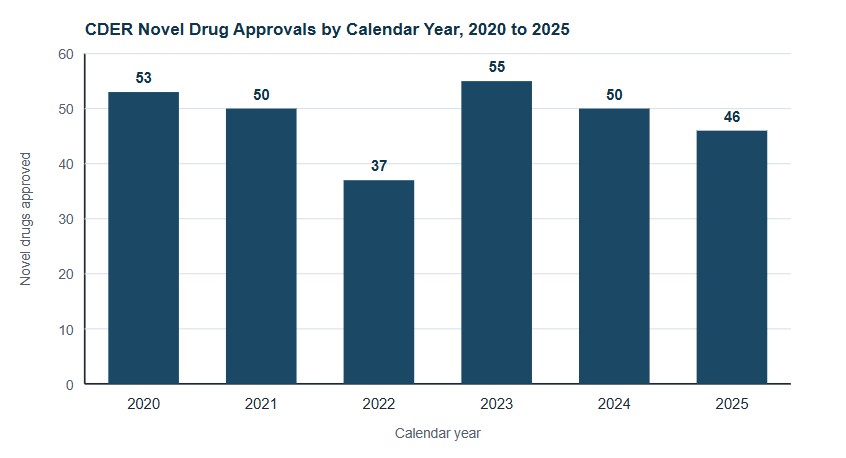
Consulting decisions are usually timing decisions, and timing decisions get made against a moving regulatory backdrop. Annual novel drug approvals from the Center for Drug Evaluation and Research have fluctuated meaningfully across recent years, which is a useful reminder that review capacity, filing quality, and competitive crowding all shift year to year. Planning a submission window on the assumption that last year’s conditions will repeat is a common and expensive error.
Governance, Access, and Information Flow
Consultants fail most often because of access, not ability. Before day one, assemble the batch records, deviation history, method validation reports, stability data, and supplier agreements the team will need. If your consultants spend three weeks chasing documents, you have paid three weeks of expert rates for administrative work.
Assign one internal owner with authority to unblock, and hold a short weekly working session rather than a monthly steering committee. Agree in advance on what the consultant may say directly to a contract manufacturer or a partner. For any work touching manufacturing quality, make sure the team is anchored in the actual text of the CGMP regulations and in 21 CFR Part 211 rather than in a generic quality framework. Firms with dedicated GMP consulting practices will structure this at kickoff without being asked.
Measuring Return on a Consulting Engagement
Four measures work better than satisfaction surveys:
- Cycle time to the next milestone. Did the submission, transfer, or campaign land earlier than the pre-engagement plan?
- Regulatory and audit outcomes. Fewer information requests, cleaner audit findings, faster closure of commitments.
- Rework avoided. Batches not repeated, studies not redone, methods not revalidated.
- Capability retained. Can your staff run the process after the consultant leaves?
Set baselines at kickoff. Independent drug development benchmarking from academic centers is a useful external reference point when your own historical data is thin. Enforcement patterns published by the FDA’s Office of Compliance also give a realistic picture of what “good” looks like in quality performance.
Common Mistakes That Waste Consulting Budget
- Hiring for a topic instead of a decision, then being surprised by a generic report.
- Buying brand credibility and receiving junior staff.
- Running the engagement through a monthly committee that meets after every decision point has passed.
- Withholding bad data, which guarantees advice built on a fiction.
- Ending the engagement without a knowledge transfer session and written handover.
- Re-hiring the same firm for the same problem, which is a sign the first engagement never addressed the cause.
Knowledge Transfer and a Clean Exit
The best engagements end with your team more capable, not more dependent. Require a handover package: decision log, open risks, the reasoning behind each recommendation, and the source data. Ask for training sessions on anything your staff will now own. Academic programs such as the biomanufacturing research groups at major engineering schools publish openly on process understanding, and pointing your team toward that material after an engagement costs nothing and compounds well.
For companies moving from development into distribution, plan the exit around the next regulatory obligation rather than the calendar. Serialization and traceability duties under the Drug Supply Chain Security Act arrive on their own schedule, and an advisor who understood your process is far cheaper to re-engage briefly than a new firm learning it from scratch. Emerging companies without in-house infrastructure often keep a standing relationship with a biotech consulting partner for exactly this reason.
See How DES Pharma Approaches Drug Development
FAQs About Working With Pharmaceutical Management Consultants
What is the difference between pharmaceutical management consulting and technical consulting?
Management consulting addresses organizational and portfolio questions such as prioritization, structure, and partnering. Technical consulting addresses the science and operations: CMC strategy, analytical methods, process development, quality systems, and supply. Many programs need both, but the people who do them well are rarely the same people, so evaluate each capability separately.
How long should a pharma consulting engagement last?
Most high-value engagements run six to sixteen weeks against a named decision. Longer arrangements are appropriate for interim leadership, sustained remediation, or ongoing advisory retainers, but an open-ended engagement without milestone reviews tends to drift into staff augmentation at premium rates.
How do I evaluate a consultant’s regulatory credibility?
Ask for specific filing and inspection experience: which submission types, which agencies, which product modalities, and what happened afterward. Credible practitioners describe questions they received and how they resolved them. Vague references to broad regulatory experience without product specifics are a warning sign.
Should a small biotech use consultants or hire full-time staff?
Hire permanently for capabilities you will use continuously, such as program leadership and quality oversight. Use consultants for episodic, deep-specialty needs: a first submission, a comparability strategy, a site transfer, a remediation. The test is whether the need recurs monthly or once every few years.
What should be in the contract to protect the program?
Named individuals with committed time, a written scope tied to deliverables, clear intellectual property and confidentiality terms, conflict-of-interest disclosure for competing programs, defined data access, and an explicit handover requirement at close. Add a short review checkpoint so either party can stop work that is not producing value.
Closing Thoughts
Good consulting in this industry is not about borrowed prestige. It is about putting experienced judgment next to a specific decision, giving that judgment real data, and holding it to a measurable outcome. Companies that write sharp briefs, grant access early, insist on named practitioners, and plan the exit at kickoff consistently get more from the same budget than companies that buy a broad assessment and hope for insight. If you are scoping a program decision now, DES Pharma Consulting can help you frame it in terms that produce an answer rather than an artifact.
Follow along for practical CMC, quality, and regulatory guidance: DES Pharma on X and DES Pharma on LinkedIn.

Matt specializes in Process Development (PD) and Chemistry, Manufacturing, and Controls (CMC) strategy, helping life sciences companies navigate early-stage development, lab innovation, and technical regulatory hurdles.
Reach out to Matt on LinkedIn.